
A noise gate works by controlling audio levels, muting sounds that fall below a set threshold, which effectively reduces unwanted background noise. When the audio signal exceeds this threshold, the gate opens, allowing sound to pass through; when it drops below, the gate closes. This mechanism enhances clarity in recordings and boosts intelligibility in speech and music. By adjusting parameters like attack and release times, you can fine-tune the noise gate’s performance to suit your specific needs. Understanding how a noise gate works is essential for creators, gamers, and musicians who want to optimize their audio experience. Learn more about signal detection, applications, and tips for maximizing your microphone setup to achieve the best sound quality.
Key Takeaways
- A noise gate controls audio levels by muting sounds below a set threshold, thus reducing unwanted background noise.
- It operates in open (signal passes) and closed (signal blocked) states based on user-defined thresholds.
- Timing controls like attack and release settings influence how quickly the gate responds to audio signals.
- Commonly used in audio production, noise gates enhance vocal clarity and prevent feedback in live settings.
- Musicians benefit from noise gates by maintaining sound integrity during recordings and improving mixing quality.
How Noise Gates Can Transform Your Audio Experience
When you incorporate a noise gate into your audio setup, you can greatly enhance clarity in music, speech, and streaming, transforming your audio experience. Noise gates effectively reduce ambient noise, such as HVAC hum and room tone, allowing for cleaner tracks. This audio enhancement sharpens speech intelligibility in podcasts and webinars by muting unintentional sounds. The threshold setting of a noise gate is crucial for determining which signals are heard, ensuring only the desired audio is amplified. Additionally, a noise gate acts as an intelligent filter that eliminates unwanted background noise while allowing desired sounds to pass.
Incorporating a noise gate elevates clarity in music and speech, transforming your entire audio experience.
In musical recordings, they eliminate low-level hiss and handling noise, resulting in focused performances. With an improved signal-to-noise ratio of up to ~18 dB, listeners experience a noticeable difference. Moreover, the dynamic range control provided by a noise gate helps maintain a balanced audio level, further enhancing the listening experience.
Ultimately, the use of noise gates can revolutionize your audio setup, directing attention to the primary sources and elevating overall sound clarity.
Noise Gate: Understanding Signal Detection and Thresholding
Understanding how a noise gate operates hinges on two key processes: signal detection and thresholding. In the context of a noise gate, level detection employs methods like peak or RMS detection, which feed data into threshold comparison logic. This logic continuously assesses the detected level against a user-defined threshold, deciding when to apply attenuation.
By grasping the principles of signal detection and thresholding, you can effectively utilize a noise gate to manage unwanted noise while preserving audio integrity. Intelligent noise gates further enhance performance by dynamically adjusting based on the noise floor, making your noise gate even more effective. Additionally, the noise gate’s ability to suppress signals below a specified threshold allows for greater control over audio levels and reduces unwanted noise.
Once a threshold is evaluated, gain computation determines whether the signal remains unaffected or is attenuated. This precise interaction allows you to manage unwanted noise effectively while ensuring a cleaner and more enjoyable listening experience.
Open and Close Behavior of Noise Gates
A noise gate operates with two distinct states: open and closed, which dictate how audio signals are processed. This open and close behavior of noise gates is crucial for managing audio quality. When the input exceeds the threshold, the gate opens, allowing desired audio to pass while suppressing unwanted noise.
Conversely, the gate closes when the signal falls below the threshold, effectively blocking or attenuating background sounds. You can adjust the threshold to fine-tune the open and close behavior of noise gates; lowering it makes opening easier, while raising it increases difficulty. Balancing these adjustments is essential to avoid chatter and to guarantee a smooth auditory experience, especially with fluctuating signals or during quiet passages. Understanding the open and close behavior of noise gates is vital for creators, gamers, musicians, and professionals looking to optimize their audio setup, as noise gates automatically turn off a channel when the signal is absent, providing a solution for suppressing mic bleed.
Timing Controls: Attack and Release
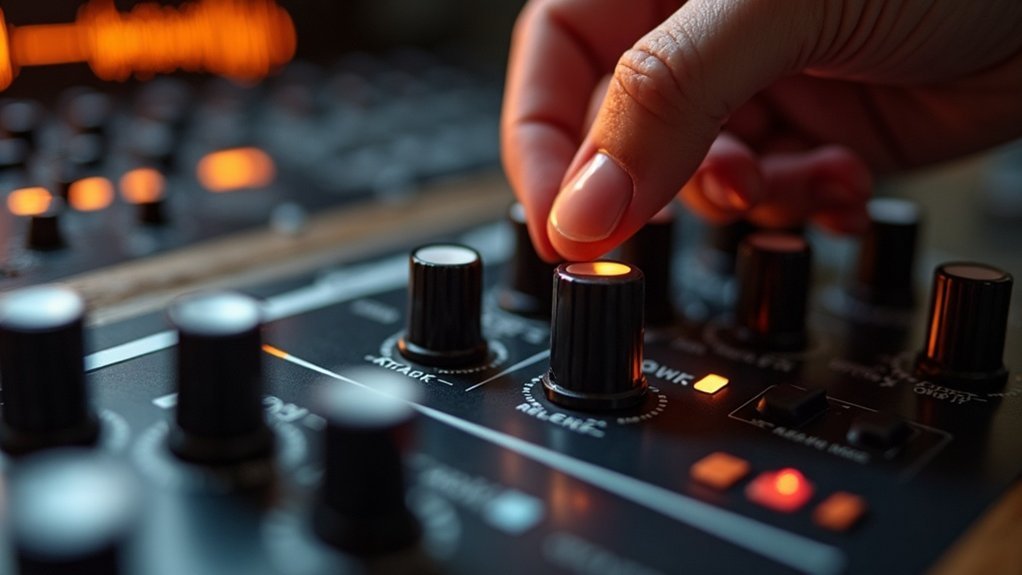
The open and close behavior of noise gates is complemented by timing controls: attack and release. These timing controls—specifically the attack and release settings—greatly influence how audio signals are processed. Understanding these timing nuances is key for effective transient management, particularly when utilizing noise gates.
- Attack Dynamics: Fast attack times preserve sharp transients, ensuring that the sound retains its punch, while slower settings soften the onset, altering envelope shaping. This is crucial for mastering attack characteristics in your audio. Additionally, the noise gate helps manage unwanted background noise, allowing for cleaner recordings. A high signal to noise ratio ensures that the desired sound is distinctly audible over any background interference.
- Release Profiles: Short release times create abrupt cutoffs, which can be useful in certain contexts, whereas longer settings allow for natural decay characteristics. Balancing these release settings is essential for maintaining audio integrity. Additionally, effective audio gating can dramatically enhance the overall quality of your mix.
- Timing Balance: A fast attack with a slow release yields crisp entries with smooth fade-outs, avoiding unnatural level changes. This balance is vital for achieving the desired dynamics in your audio, particularly in recording scenarios.
Mastering these timing controls—attack and release—enhances your audio’s clarity and impact, making it indispensable for creators, gamers, musicians, and professionals alike. Understanding how to manipulate these settings can significantly improve your projects, whether you’re podcasting, streaming, or recording.
Common Applications of Noise Gates in Audio Production
Noise gates play an essential role in various audio production contexts, significantly contributing to cleaner and more defined soundscapes. When it comes to vocals, noise gates enhance vocal clarity by effectively reducing background noise and breath sounds. This is particularly important because an audio processor eliminates sounds below a specified threshold, ensuring that recordings remain crisp and focused. Additionally, they improve the signal-to-noise ratio by up to 18dB, making audio more intelligible.
For drums, their use in audio production helps achieve drum isolation, allowing each hit to stand out while minimizing mic bleed. Electric guitars also benefit from increased cleanliness, as noise gates cut unwanted noise during pauses, leading to a more polished sound.
In live settings, noise gates are crucial for preventing feedback, ensuring clear sound reinforcement during performances. Furthermore, their importance extends to broadcast quality and podcast enhancement, where they eliminate low-level noise.
This application of noise gates in audio production makes your recordings more professional and engaging, ultimately benefiting creators, gamers, and musicians alike. By leveraging noise gates, you can enhance the overall quality of your projects, ensuring that every detail shines through.