Directional patterns are your answer to which polar pattern rejects background noise most effectively. You’ll reject the most background noise with directional designs like cardioid, supercardioid, and hypercardioid microphones. Cardioid offers a practical balance, reducing noise by roughly two-thirds compared to omnidirectional designs, making it ideal for podcasters and streamers seeking affordable solutions without sacrificing audio quality.
Supercardioid and hypercardioid patterns provide stronger isolation with narrower pickup angles, shifting maximum rejection to the sides and rear—a critical advantage for gaming setups and professional recording environments. Understanding which polar pattern rejects background noise best depends on your specific use case: cardioid works well for most creators, while supercardioid excels in high-noise settings like live streaming studios.
Figure-8 patterns excel at eliminating side interference through nulls at 90° and 270° off-axis, though they’re less common for content creators. Strategic placement of your microphone‘s null zones toward noise sources dramatically amplifies these rejection strengths, transforming how polar patterns reject background noise in your recording space. By selecting the right directional microphone and positioning it correctly, you’ll maximize noise rejection regardless of your budget or setup complexity.
Key Takeaways
- Cardioid patterns provide approximately two-thirds noise reduction with maximum rejection at 180 degrees behind the microphone.
- Supercardioid and hypercardioid patterns offer stronger isolation with narrower front pickup angles and shifted rejection zones at 110–125 degrees.
- Figure-8 patterns create nulls at 90° and 270° off-axis, enabling effective side rejection in close-proximity recordings.
- Omnidirectional microphones capture noise equally from all directions, providing zero background-noise rejection in untreated spaces.
- Directional patterns like cardioid achieve a 4.8 dB directivity index, rejecting diffuse background noise more effectively than omnidirectional designs.
Cardioid: Why It’s the Safe Starting Choice
If you’re choosing a microphone pattern for the first time, the cardioid pattern is your best starting point. As the safe starting choice for microphone selection, cardioid gives you a practical balance of direct sound capture and background-noise reduction that works across most recording scenarios.
Cardioid advantages include roughly two-thirds noise reduction compared to omnidirectional patterns, making it ideal for vocals, podcasting, and streaming in typical home rooms—whether you’re a creator, gamer, or musician just getting started with affordable microphones. The cardioid pattern’s heart-shaped polar pattern ensures maximum rejection occurs at 180 degrees directly behind the microphone.
Why cardioid’s the safe starting choice becomes clear when you apply strategic microphone placement to amplify these benefits. Position the rear null toward your noisiest source, keep the mic close to your mouth for lower gain, and you’ll minimize room reflections effectively. The cardioid distance factor of 1.7 allows you to work from greater distances in noisy environments compared to omnidirectional microphones, which provides additional flexibility in your recording setup. For even more specialized noise rejection in challenging environments, supercardioid and hypercardioid patterns offer narrower pickup zones with additional rear rejection characteristics.
This safe starting choice approach works whether you’re recording podcasts, streaming gameplay, or capturing vocals without expensive acoustic treatment.
Understanding cardioid as your safe starting choice helps you avoid the overwhelm of narrower, more specialized patterns. It’s the dependable default before moving to omnidirectional, figure-eight, or supercardioid options—giving you a foundation to learn proper microphone technique and placement.
For creators, podcasters, gamers, and musicians working with budget-conscious setups, choosing the cardioid pattern as your safe starting choice delivers professional results without requiring advanced knowledge of pattern selection or room acoustics.
Supercardioid and Hypercardioid: Stronger Isolation for Tough Noise
Supercardioid advantages include stronger side rejection with a ~115° front pickup angle, ideal for live stages and streaming setups. Hypercardioid applications prioritize maximum isolation through a narrower ~105° lobe and higher directivity index, making it essential for podcasters and musicians working in noisy spaces.
Supercardioid and hypercardioid patterns deliver stronger isolation for live stages, streaming, podcasting, and noisy recording environments.
Both supercardioid and hypercardioid patterns shift maximum rejection to ~110–125° off-axis rather than directly behind the mic, fundamentally changing how you approach microphone placement for tough noise scenarios.
Sound rejection techniques depend on strategic placement:
- Position unwanted noise sources in null zones, not rear lobes—critical for creators recording in non-treated rooms.
- Match microphone placement discipline to your environment’s noise profile to maximize the benefits of stronger isolation.
- Expect rear pickup trade-offs with both patterns, especially in live or open recording spaces. Hypercardioid mics demonstrate greater rear sensitivity compared to supercardioid alternatives, requiring careful consideration during placement decisions.
- Use hypercardioid for instrument isolation in extreme conditions, or when gaming streams pick up background distractions. Condenser microphones offer enhanced sensitivity for capturing subtle instrument details alongside directional rejection benefits.
- Leverage supercardioid for balanced front focus and usable rear control during podcasting sessions or professional recordings.
Unlike omnidirectional microphones, which pick up sound equally from all directions, supercardioid and hypercardioid patterns provide focused front pickup for precise source capture.
For affordable microphones designed to handle challenging acoustic environments, understanding supercardioid and hypercardioid patterns for tough noise rejection**** ensures you choose the right pickup pattern for your specific setup—whether you’re streaming, recording music, gaming, or producing podcasts.
Figure-8 Patterns: Solving Side-Noise Problems
You’ll find that figure-8 microphones create nulls at 90° and 270° off-axis, delivering exceptional side rejection through their pressure-gradient design. By positioning your mic strategically, you can aim these nulls directly at noise sources alongside you—room reflections, nearby instruments, or ambient bleed. The rejection of off-axis sounds ensures that side-positioned noise sources are minimized without affecting your primary recording direction. This directional capability becomes even more pronounced when proximity to the source increases the bass response, allowing you to maintain clarity while capturing focused audio. The figure-8 pickup pattern is particularly effective in controlled environments where precise null placement can be achieved.
This figure-8 null placement technique proves invaluable for two-person interviews and close-proximity recording where side noise dominates your environment, improving signal-to-noise ratio without modifying your source.
For content creators and streamers working with affordable microphones, mastering how figure-8 patterns solve side-noise problems**** transforms your recording quality without requiring expensive isolation booths.
Musicians and podcasters particularly benefit from understanding that solving side-noise problems with figure-8 mics enables cleaner recordings in untreated spaces.
Whether you’re gaming with a teammate nearby or recording voiceovers in a busy environment, this null placement strategy gives you professional-grade side rejection that budget-friendly figure-8 options deliver, making it an essential technique across every stage of your recording setup.
Skip Omnidirectional in Noisy Rooms: Here’s Why
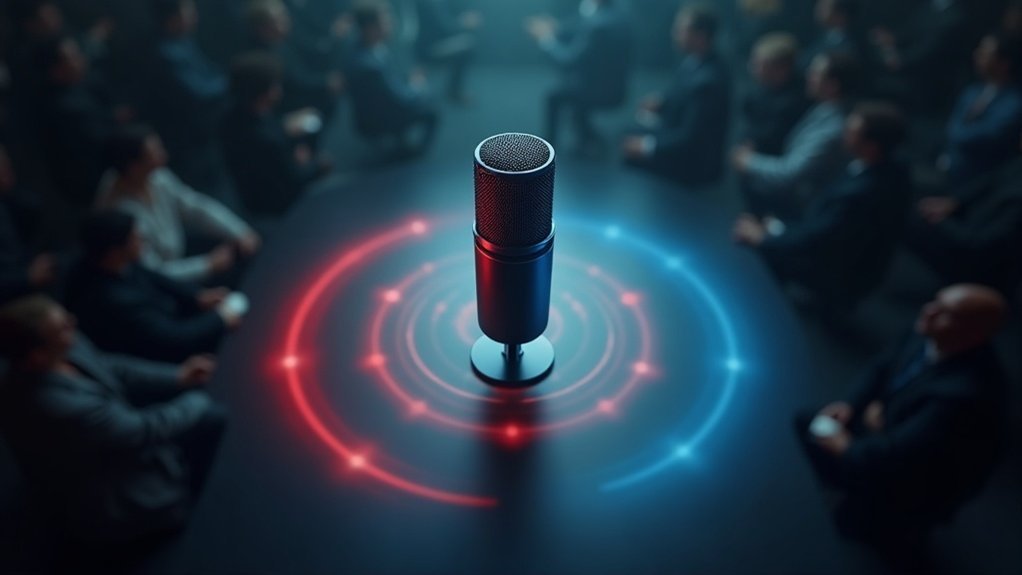
Omnidirectional microphones pick up sound equally from all 360° around the capsule, making them fundamentally incompatible with noisy recording environments. When you skip omnidirectional in noisy rooms, you immediately gain control over your audio quality.
You’ll face significant omnidirectional drawbacks when recording anywhere without perfect acoustic treatment—a reality most creators, gamers, and streamers face in real-world spaces.
- Your directivity index remains at 0—zero background-noise rejection
- Fan noise, traffic, and echoes penetrate equally from every angle
- Room ambience becomes glaringly obvious in playback
- You’re forced to choose between capturing your source or accepting degraded audio quality
- Professional and amateur creators alike avoid omni patterns in untreated spaces
Why skip omnidirectional mics for noisy environments? The noise capture problem compounds rapidly in any untreated room. Cardioid microphones achieve a directivity index of 4.8 dB, providing measurable rejection of diffuse background noise compared to omnidirectional designs. Supercardioid microphones offer even stronger side rejection with their narrower pickup angle, making them exceptionally effective in isolating voice from side noise sources. Unlike omnidirectional patterns, condenser and dynamic microphones can both be engineered with directional patterns to provide superior noise isolation in real-world recording scenarios.
Your podcast, gaming stream, or recording session demands better isolation than omnidirectional patterns can provide. This is precisely why skipping omnidirectional in noisy rooms represents the smartest microphone choice for streamers, podcasters, and musicians working on a budget without treated acoustics.
Skip omnidirectional entirely and embrace cardioid or tighter patterns instead—they’re engineered for real-world recording where creators need isolation and clarity.
Whether you’re building an affordable home studio for gaming, podcasting, or music recording, rejecting omnidirectional designs in favor of directional patterns eliminates the noise battle before it starts.
Position Your Mic to Maximize Rejection
Choosing a directional pattern solves half the noise problem—proper microphone positioning solves the other half. To position your mic to maximize rejection, you’ll need to align noise sources with your mic’s least sensitive zones.
Point cardioid rear lobes toward unwanted sound for -20 to -25 dB attenuation. Position supercardioid and hypercardioid patterns to exploit their tighter 105–115° front pickup angles. For figure-8 mics, angle side nulls toward interference. Understanding cardioid microphone pickup patterns helps you identify which rejection zones are strongest for your specific microphone type.
Maximizing mic rejection strength depends on matching microphone angles to your specific noise sources’ locations. This positioning technique is especially valuable for podcasters and streamers working in untreated spaces, where you can’t always control ambient noise. Off-axis coloration can still affect your tone when sources aren’t perfectly aligned with rejection zones, so test different angles during setup to ensure optimal placement.
Whether you’re gaming, recording music, or producing content on a budget, learning to position your microphone to maximize rejection will dramatically improve your audio quality without expensive acoustic treatment.
Remember: rejection strength varies across frequencies, so positioning works best when stationary noise can be precisely targeted off-axis. Test different angles during your mic setup to discover your sweet spot.
The goal is making your affordable microphone perform like a premium solution through smart placement strategy rather than costly gear upgrades.
Match Your Pattern to Your Noise Environment
The microphone pattern you select should align with where your unwanted noise originates. When you match your pattern to your noise environment, you’ll maximize rejection by pairing directional advantages with specific noise sources.
Cardioid and supercardioid patterns excel when noise comes from behind your mic, making them ideal for creators and streamers working in less-than-ideal acoustic spaces. Understanding how polar patterns work helps you select the most effective microphone for your specific recording situation.
Figure-8 patterns create strong side nulls, perfect for rejecting lateral interference in gaming setups or podcast studios. However, omnidirectional mics offer no rejection, so they’re unsuitable for noisy environments where you need to match your pattern to your noise environment for clean audio capture. Unwanted sound often bounces off surfaces and reflects in multiple directions, which is why understanding how patterns handle reflections matters for your recording space.
Key considerations for matching your pattern to your noise environment:
- Rear noise demands cardioid or supercardioid patterns—essential for podcasters and musicians recording at home.
- Side interference requires figure-8’s 90° and 270° nulls for professional streaming setups.
- Front-origin noise leaves you vulnerable regardless of pattern selection.
- Strategic mic placement amplifies your pattern’s rejection strengths when properly aligned with noise sources.
- Room acoustics demand pattern-environment alignment for clean sound capture across gaming, recording, and live streaming applications.
When you match your pattern to your noise environment effectively, you’ll achieve professional-grade audio quality even with affordable microphone options.
This fundamental principle applies whether you’re recording podcasts, streaming games, or producing music on a budget.