
A polar pattern defines your microphone’s directional sensitivity, illustrating how it captures sound from different angles. Understanding what a polar pattern is crucial for optimizing microphone placement and enhancing audio clarity in various settings. For instance, a cardioid polar pattern focuses on sound directly in front while minimizing background noise, which is particularly beneficial for creators, gamers, and musicians. The shape of the polar pattern significantly influences your recordings, affecting sound isolation and overall quality. By exploring more about polar patterns, you can also discover how frequency response and room acoustics impact your microphone’s performance, ensuring you make informed choices for podcasting, streaming, and recording.
Key Takeaways
- A polar pattern defines a microphone’s directional sensitivity, illustrating how it responds to sound from various angles.
- It shapes audio capture effectiveness, enhancing sound isolation and clarity while minimizing background noise.
- Major types include omnidirectional, cardioid, supercardioid, and figure-8, each suited for different recording scenarios.
- Room acoustics influence polar pattern choice, as untreated spaces benefit from tighter patterns to reduce reflections.
- Polar patterns are measured in controlled environments, ensuring accurate data for optimal microphone performance selection.
What Exactly Is a Polar Pattern?
A polar pattern is fundamentally a microphone’s directional sensitivity map, illustrating how it responds to sound from various angles around its capsule. This design shapes how effectively the microphone captures audio, highlighting areas of sound isolation and rejection. Understanding the polar patterns can help you choose the right microphone for specific applications, ensuring optimal performance.
When discussing what exactly is a polar pattern, it’s typically represented in a circular coordinate system, showing sensitivity across 360°. This reveals how much signal is picked up from the front, sides, or rear. Understanding this microphone directional sensitivity map helps you optimize placement, ensuring clarity in recordings while minimizing unwanted noise. By mastering the concept of polar patterns, you can enhance your audio projects, creating a more professional and polished sound environment. Additionally, knowing the importance of understanding polar patterns can significantly impact your recording quality, allowing you to make informed choices about your microphone setup.
Whether you’re podcasting, streaming, or gaming, knowing what a polar pattern is can significantly impact your recording quality, allowing you to make informed choices about your microphone setup. Additionally, selecting the right polar pattern can minimize unwanted sound interference and improve overall recording quality.
Major Types of Polar Patterns Explained
In this section, you’ll explore the major types of polar patterns and their distinct characteristics.
The omnidirectional pattern captures sound equally from all directions, making it ideal for specific recording scenarios. Additionally, understanding polar patterns can significantly improve your recording quality by allowing you to select the appropriate microphone for your environment. Directional microphones, which are designed for specific sound sources, can effectively suppress unwanted noise and enhance clarity in various settings. For instance, cardioid microphones are particularly effective in live sound applications, as they focus on sound coming from the front while minimizing background noise.
You’ll also examine various directional patterns, each designed for unique applications, emphasizing how their sensitivity and rejection capabilities can enhance your audio capture.
Omnidirectional Pattern Characteristics
While understanding the diverse polar patterns in microphones, the omnidirectional pattern characteristics stand out due to their ability to capture sound evenly from all directions. This spherical pickup field offers significant omnidirectional advantages, ensuring consistent sound capture across a 360° area. With no proximity effect, it maintains accurate bass response regardless of distance, making it ideal for various applications. Additionally, the absence of null points means off-axis signals experience minimal tonal degradation, allowing for natural recordings. This microphone type is especially effective for capturing ambient sounds in various environments. Whether in studio or live settings, the characteristics of the omnidirectional pattern deliver a true-to-life sound experience, enriching your audio projects with environmental context. Furthermore, these microphones are often used in acoustic measurement to ensure accurate data collection.
Understanding these omnidirectional microphone features can greatly enhance your recording quality, whether you’re a creator, gamer, musician, or professional in need of reliable audio solutions.
Directional Pattern Variations
When it comes to cardioid applications, they excel in studio settings, offering controlled side rejection. Additionally, multi-pattern capabilities allow users to switch between different polar patterns, providing versatility for various recording environments. Subcardioid features provide a wider angle, perfect for small ensembles, while supercardioid advantages include enhanced isolation in loud environments. Hypercardioid usage maximizes directivity, making it ideal for noisy settings, though it requires careful placement. Supercardioid and hypercardioid patterns are particularly effective in live sound reinforcement, further enhancing their utility. Additionally, bidirectional benefits allow for equal sensitivity at the front and rear, making them perfect for interviews.
Why Do Polar Patterns Matter for Recording Quality?
Polar patterns are essential for recording quality because they dictate how a microphone interacts with sound from various directions, directly impacting clarity and overall fidelity. Understanding why polar patterns matter for recording quality is crucial for anyone looking to enhance their audio experience. The right polar pattern improves sound isolation, reduces feedback, and controls ambient noise. This precision allows for better microphone placement, ensuring recording clarity and tonal balance. Additionally, the choice of polar patterns can significantly influence how sound is captured in different environments, further enhancing the recording process. The LeWitt 640 microphone’s dual capsules allow for versatile recording options that adapt to different polar patterns. Furthermore, selecting an appropriate microphone type can optimize the recording experience based on the desired sound characteristics.
| Aspect | Importance |
|---|---|
| Sound Isolation | Separates source from noise |
| Feedback Prevention | Reduces unwanted sound pickup |
| Ambient Control | Balances direct and room sound |
| Tonal Balance | Shapes the recording character |
Choosing the correct polar pattern is vital for achieving high-quality recordings, and recognizing why polar patterns matter for recording quality can significantly influence your setup decisions.
How Does Frequency Affect Polar Patterns?
Frequency greatly affects polar patterns, influencing microphone directivity across the audio spectrum. At low frequencies, microphones tend to lose directionality, resembling omnidirectional behavior as long wavelengths diffract around the capsule. This phenomenon can lead to a loss of focused sound capture, making it essential to choose the right polar pattern for low-frequency applications. Understanding the impact of frequency response on audio gear can further enhance this selection process.
In the mid-frequency range, particularly around 1 kHz, you can observe a microphone’s ideal polar shape, which offers balanced front focus and effective side rejection.
As frequencies rise, the influence of frequency on polar patterns becomes more pronounced, with directional microphones exhibiting sharper focus and stronger off-axis attenuation. This relationship between frequency and polar patterns can lead to complex behavior, including the emergence of additional lobes at high frequencies, which can impact the overall frequency response.
Understanding how frequency affects polar patterns is crucial for achieving excellent sound capture in your recordings, whether you’re podcasting, streaming, or making music.
Choosing the Right Polar Pattern
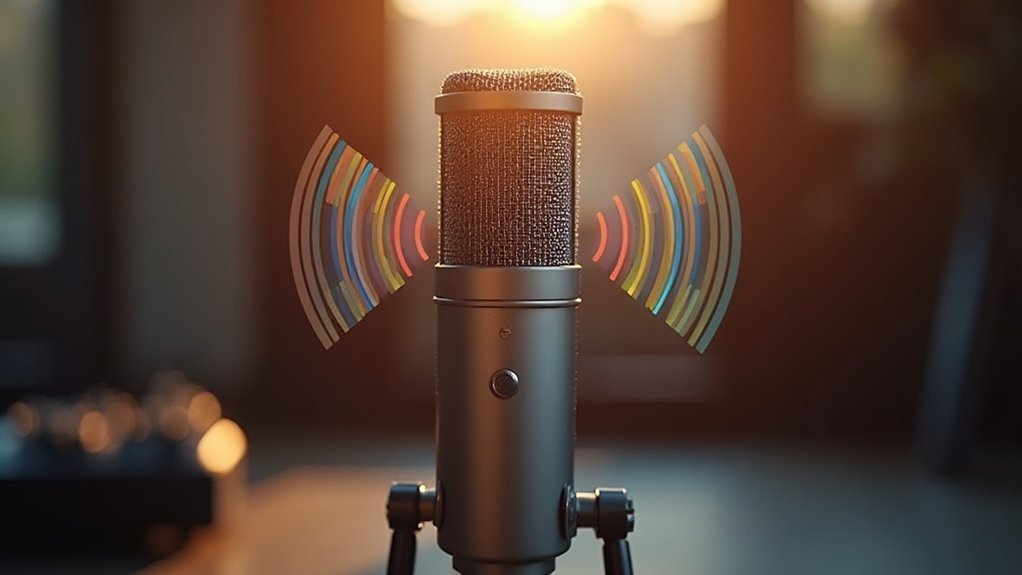
When choosing the right polar pattern for your recording needs, it’s essential to consider the source type and your specific goals. For solo voices or instruments, a cardioid pattern excels in focused capture, while an omnidirectional pattern is ideal for ensembles, creating a natural sound field.
In face-to-face interviews, opting for a figure-8 pattern allows you to capture both sides effectively. High-volume environments benefit from supercardioid or hypercardioid patterns, which provide better feedback control. If your recording scenarios frequently change, a switchable multi-pattern mic offers the versatility you need.
Additionally, don’t overlook room acoustics; untreated spaces require tighter patterns to minimize reflections and noise. By evaluating these factors, you can ensure that your polar pattern applications align with your recording objectives, ultimately helping you choose the right polar pattern for your unique situation. Furthermore, understanding cardioid microphones is crucial as they are commonly used in various recording scenarios.
Misconceptions Surrounding Polar Patterns
Understanding polar patterns is often clouded by several misconceptions surrounding polar patterns that can lead to improper microphone use and placement. Common myths include the belief that diagrams represent flat, two-dimensional circles, overlooking crucial vertical angles and frequency impacts on microphone behavior.
Recording misconceptions also suggest that tighter patterns guarantee better isolation, failing to consider rear sensitivity. Additionally, many assume all shotguns share a single polar pattern, missing their frequency-dependent characteristics.
It’s vital to recognize that acoustic interactions and placement assumptions significantly affect sound capture. Grasping these directional nuances is essential to avoid isolation challenges in diverse environments, particularly when navigating the misconceptions surrounding polar patterns. Understanding the best polar pattern for specific situations can greatly enhance your recording quality.
How Are Polar Patterns Measured and Graphed?
To accurately measure and graph polar patterns, specific methodologies are employed to guarantee reliable data capture. These polar patterns are typically measured in anechoic chambers using calibrated loudspeakers positioned at fixed distances.
Measurement techniques involve recording sound pressure levels at discrete angular steps, often every 5° to 30°, while rotating the microphone. This process of measuring polar patterns allows for a comprehensive understanding of how microphones respond to sound from different angles.
Recording sound pressure levels at discrete angles reveals how microphones respond to sound from various directions.
Data acquisition involves collecting amplitude and phase data across a frequency range, from 100 Hz to 20 kHz. After gathering raw measurements, you’ll interpolate and normalize them to create smooth polar curves.
This step is crucial in graphing polar patterns, as it ensures clarity in how directivity shifts with frequency, ultimately providing valuable insights into microphone performance. By understanding how polar patterns are measured and graphed, creators, gamers, and musicians can make informed decisions when selecting microphones for podcasting, streaming, and recording, enhancing their overall audio experience.