What Is the Difference Between Gain and Volume
Gain controls your input level and shapes tone through preamp saturation at the signal chain’s beginning, while volume adjusts output loudness after processing without altering audio character. Understanding the difference between gain and volume is fundamental to protecting your recordings and achieving professional results.
You’ll set gain to capture clean recordings and prevent clipping before compression or EQ. This distinction between gain and volume becomes critical when using affordable microphones for podcasting, streaming, or gaming—where budget equipment demands precise input management. Volume manages playback levels for listening comfort, allowing you to monitor your work without affecting the recorded signal itself.
The differences between gain and volume directly impact your recording quality. Mismanaging gain creates permanent damage you can’t fix later with volume adjustments, making it essential to get your input levels right from the start. For creators and musicians working with entry-level gear, knowing when to adjust each control ensures cleaner recordings and better post-production flexibility.
When setting up your microphone for content creation, treat gain as your first line of defense. Adjust volume only after your signal is properly gained—this workflow separates professional recordings from amateur attempts. Whether you’re podcasting, streaming, gaming, or recording music, mastering the difference between gain and volume transforms how you approach your entire setup.
Key Takeaways
- Gain controls input amplification at the source stage, while volume adjusts output level after all processing is complete.
- Gain shapes tone through preamp saturation and distortion, whereas volume only manages loudness without altering the audio character.
- Improper gain staging causes permanent clipping and distortion that volume adjustments cannot fix later in the signal chain.
- Gain directly influences how compressors, EQs, and effects respond, while volume merely controls final listening level across devices.
- Gain affects signal strength before processing for clean recordings; volume ensures playback comfort without compromising the original recording’s integrity.
What’s the Difference Between Gain and Volume?
The Difference Between Gain and Volume in Audio Systems
Though the terms are often used interchangeably in casual audio discussion, the difference between gain and volume serve fundamentally different functions in any audio system. Understanding gain vs. volume is essential for anyone recording podcasts, streaming, gaming, or creating professional audio content.
Gain controls your input level and amplification ratio, directly shaping tone through preamp saturation. This is where the distinction between gain and volume becomes critical—gain sits at your signal’s front end, affecting how your microphone captures and processes sound before it reaches your recording device. Proper gain staging ensures consistent dB levels throughout your entire processing chain, which is necessary to maintain recording levels before mixing and improve your overall mixing decisions. Maintaining adequate headroom before clipping protects your recording from distortion and preserves audio quality.
Gain controls input level at your signal’s front end, directly shaping tone before sound reaches your recording device.
Volume adjusts your output level for listening comfort and is positioned at the output stage of your signal chain.
For creators and musicians using affordable microphones, mastering the difference between gain and volume prevents control confusion when optimizing signal clarity. Improper gain settings risk audio distortion and noise, while volume adjustments merely affect loudness without altering character.
A properly set gain level allows your microphone to capture clean, intentional audio, while volume control simply determines how loud your output plays back.
Understanding how gain differs from volume guarantees you’re not just loud—you’re clean and professional. Whether you’re podcasting, streaming, gaming, or recording music, getting this distinction right ensures your affordable microphone setup delivers broadcast-quality results without unnecessary noise or distortion.
How Do Gain and Volume Work in Your Signal Chain?
You’ll route your signal through three distinct stages: gain enters first at your input stage, processing happens in the middle through EQs and effects, and volume exits last at your output stage.
This sequential arrangement means you’re setting your input level before any processors touch the signal, then adjusting your final loudness after all that processing is complete. Understanding how microphone gain functions at this initial stage is essential for capturing clean audio before any processing occurs.
The position of each control in your chain directly determines what it influences and how it shapes your sound. Maintaining proper gain staging at each amplification point—including your mic, preamp, plugins, and faders—prevents unwanted distortion while preserving audio fidelity throughout the recording and mixing process. Aiming for peaks around -5 dB to -10 dB ensures you maintain adequate headroom for processing without introducing clipping or unwanted artifacts.
Gain Enters First
The signal chain‘s foundation begins when gain enters first, which controls your audio signal’s input level before any processing occurs. You’ll establish proper gain structure at your preamp settings—whether on a microphone preamp, audio interface, or pedal input stage. This initial amplification affects your entire signal integrity and audio dynamics downstream. Understanding mic level in your signal chain helps you recognize how input amplification translates to output performance.
Understanding why gain enters first is critical for affordable microphone setup. When gain enters first in your chain, it determines how strongly subsequent processing responds to your source material. Higher gain drives your circuit harder, potentially introducing desirable distortion levels or unwanted breakup that compromises recording quality for podcasting or streaming.
For creators and gamers relying on budget-friendly microphones, controlling gain entry early prevents clipping and distortion before compression or EQ engages. By controlling amplification effects early, you’re tonal shaping before EQ, compression, or effects activate downstream. Balancing gain and volume is essential for optimal sound quality throughout your entire production process. Mismanagement of gain during recording cannot be fixed by adjusting volume later, making proper gain staging the foundation for clean audio.
This foundational principle of gain entering first ensures proper recording clarity that depends on this critical first step in processing order.
Setting correct input thresholds when gain enters first determines whether your microphone captures clean vocals for podcasting, crisp dialogue for gaming streams, or transparent instrument recording.
Professional signal integrity starts with respecting this fundamental rule: gain always enters first, protecting your audio quality throughout every subsequent processing stage.
Volume Exits Last
- Volume Exits Last in your signal chain—governing final loudness leaving amplifiers or mixers to speakers before audio reaches your audience.
- Adjusts loudness perception independently from tone-shaping decisions, ensuring your volume exit maintains clean dynamics without coloring your original recording.
- Matches playback levels across devices within your signal chain, critical for creators and streamers who need consistent volume exiting to different monitoring setups.
You’ll recognize volume as distinctly separate from gain—it shapes sound dynamics through level management alone. Unlike gain, which adjusts input signal levels before processing, volume operates only on the final output without affecting tone or character.
When volume exits last in your chain, it preserves all prior processing while delivering your intended listening experience.
For podcasters, musicians, and gamers using affordable microphones, understanding where volume exits in your setup prevents distortion and ensures professional-sounding output across streaming platforms and recording sessions.
Processing Happens Between
Because gain and volume occupy different positions in your signal chain, they shape your sound in fundamentally different ways—processing happens between your input stage and output stage. Gain operates at the input stage before processing occurs, while volume operates at the output stage after all processing is complete. This placement matters tremendously for sound engineering.
Your gain setting determines how hard you drive subsequent processors, directly influencing audio dynamics and distortion effects. Understanding where processing happens between** your input and final output is crucial for proper gain staging. Compressors, EQs, and distortion pedals all respond differently based on input level, which means everything that happens between** your microphone and listener depends on this initial gain decision. Many players overlook how gain affects distortion level independently from overall volume control.
Volume, conversely, handles final level management without altering tone shaping. When you recognize that processing happens between gain and volume stages, you unlock the ability to craft professional results. This understanding of what happens between input and output stages is essential whether you’re recording podcasts, streaming gameplay, or capturing music performances.
Intelligent gain staging ensures your processors receive optimal input levels, allowing all processing that happens between your source and audience to work at peak efficiency.
Why Does Gain Affect Tone and Volume Doesn’t?
Gain affects tone through three critical mechanisms:
Gain affects tone through distortion levels, signal integrity, and dynamic range—reshaping your audio at the source.
- Distortion levels — Higher gain drives your preamp harder, introducing saturation and harmonic coloration that reshape frequency response. This is precisely why gain affects tone differently than simple loudness adjustments—it’s changing the signal itself, not just its output level.
- Signal integrity — Gain determines how forcefully circuitry responds, altering tonal shaping at the source before any processing. When you’re recording podcasts, streaming gameplay, or capturing vocals, how gain affects tone at the input stage defines your entire sonic character. Poor gain staging can degrade signal to noise ratio, making unwanted background noise more prominent in your final recording.
- Dynamic range — Increased gain compresses your audio clarity by pushing signals into clipping zones, fundamentally altering how your microphone captures detail and presence.
Volume simply adjusts loudness without modifying these gain characteristics. You’re controlling output level after processing completes, leaving your signal’s fundamental character intact.
This is the core reason gain affects tone while volume doesn’t**—gain operates upstream in your signal chain**, whereas volume operates downstream.
This distinction lets you achieve distorted, saturated tones quietly or clean, transparent tones loudly. For affordable microphone setups, mastering why gain affects tone and volume doesn’t means you’ll optimize your recordings regardless of your equipment’s price point.
How Do Mixers, Amps, and Interfaces Label These Controls?
When you’re working with mixers, amps, and audio interfaces, you’ll notice that manufacturers consistently label input controls as gain, trim, or preamp—while they reserve volume, level, fader, or master for output stages.
This labeling convention reflects the signal chain: gain comes first to set how hard you’re driving the input stage, and volume comes last to control final loudness after processing. Proper gain structure ensures balanced audio input levels across all your channels, creating a stable foundation for effective mixing.
Understanding these patterns across your gear helps you quickly locate which control shapes your tone versus which one simply adjusts playback loudness.
Mixer Input and Output
On your mixer, you’ll encounter:
- Input stage controls (gain, trim, input gain) that set incoming signal strength before EQ adjustment and dynamic range processing. These mixer input controls are critical for establishing your microphone’s initial signal level, whether you’re podcasting, streaming, or recording music. Microphone gain specifically controls the amplification of incoming signals from your microphone before they’re processed further in your audio chain.
- Channel faders managing individual mixer signal loudness for channel balance across all your connected devices and microphones.
- Master faders and mixer output controls directing final output consistency to speakers, audio interfaces, or buses—essentially determining what reaches your audience during live streams or recorded sessions.
Gain staging through preamp settings establishes signal integrity early in your signal chain. Your mixer’s input and output configuration determines what actually reaches your audience, making proper labeling recognition essential for maintaining audio clarity. Incorrect gain settings can lead to audio distortion that compromises the quality of your entire production.
For content creators, gamers, and musicians working with affordable microphone setups, understanding how your mixer inputs connect to your microphone and how mixer outputs feed into your streaming software or recording interface can mean the difference between professional-sounding audio and frustrating technical issues.
Proper mixer input and output management ensures your podcast, gameplay, or musical performance reaches listeners with optimal clarity and consistency throughout your entire signal chain.
Amp and Interface Controls
| Device | Gain Control | Volume Control |
|---|---|---|
| Amplifier | Preamp drive; influences distortion control | Master output; adjusts loudness only |
| Interface | Mic/instrument input level; affects recording clarity | Headphone/monitor output; listening level |
| Mixer | Input trim; shapes preamp adjustment | Channel fader; manages output balance |
When working with amplifier and interface controls, understanding these distinctions directly impacts your recording quality and streaming setup. For podcasters, musicians, and content creators relying on affordable microphones, proper interface and amp control management ensures your signal reaches optimal levels before it ever hits your recording software. The microphone signal chain begins with your preamp, which is why controlling gain at the input stage is critical for capturing clean audio without distortion.
These amp control and interface settings work in tandem with your microphone’s capabilities. Whether you’re using an entry-level USB interface or routing through external preamps, grasping how these controls on amplifiers and audio interfaces interact guarantees proper signal clarity during recording and precise monitoring levels for live streaming or overdubbing sessions.
When Should You Adjust Gain Instead of Volume?
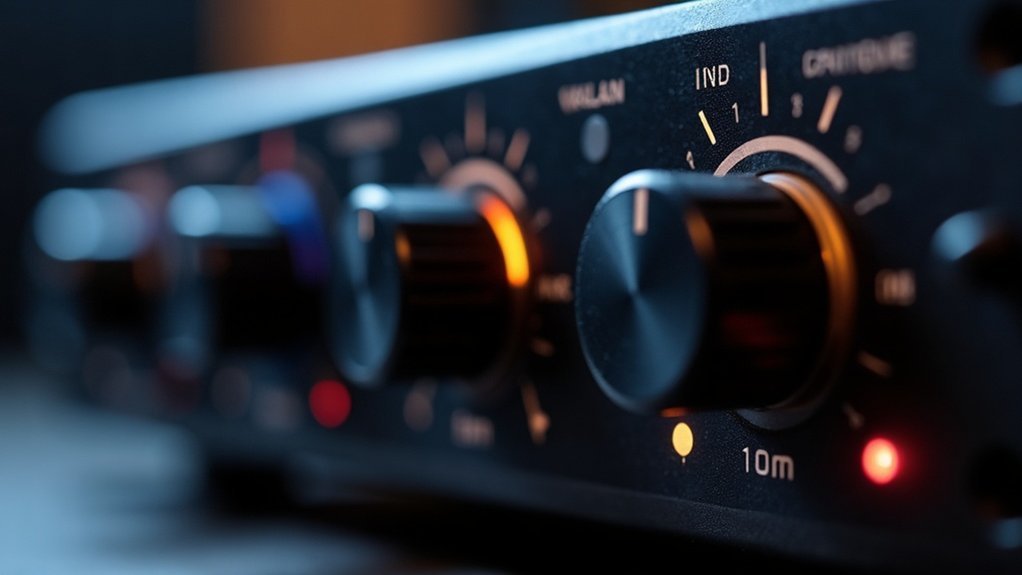
Understanding when to adjust gain instead of volume is crucial for proper recording setup. You’ll adjust gain when establishing proper input levels before downstream processing. Consider these gain adjustment scenarios where adjusting gain instead of volume makes the difference:
- Signal capture: Raise gain at the source to keep quiet microphones above the noise floor without clipping. This is when you should adjust gain instead of volume to maintain signal integrity from the start.
- Tone shaping: Drive preamp settings harder for saturation and character before setting output volume. Knowing when to adjust gain instead of volume determines whether you achieve natural saturation or digital distortion.
- Live mixing: Balance multiple inputs so each channel enters your console at consistent, usable levels. This is one of the most important times you should adjust gain instead of volume for smooth mixing.
Gain staging prevents distortion while preserving signal clarity benefits. This input level importance makes gain your first control during microphone setup strategies and recording quality factors—establishing clean headroom before volume adjustments. An audio interface converts analog signals from microphones into digital data your computer can process, making proper gain staging at this device essential for capturing quality recordings.
For affordable microphone users and budget-conscious creators, understanding when to adjust gain instead of volume transforms your recording quality immediately.
Whether you’re podcasting, streaming, or gaming with a budget microphone, deciding when you should adjust gain instead of volume at the preamp stage ensures professional results without expensive gear.
Mastering this foundational technique separates clean recordings from muddy, distorted audio across every setup.
When Should You Adjust Volume Instead of Gain?
While gain controls your input signal strength, volume adjusts the output level after processing—and most of your daily loudness changes happen at the volume stage. When should you adjust volume instead of gain? The answer is simple: you’ll rely on volume control techniques whenever your mix sounds balanced but needs adjustment for the listening environment. This distinction matters whether you’re recording podcasts, streaming gameplay, or laying down music tracks. Faders, speaker knobs, and device controls all function as output-stage tools that preserve your recorded signal integrity. Deciding when to adjust volume rather than gain keeps your initial recording clean and professional. Whether you’re mixing tracks, monitoring playback, or managing amplifier output, volume remains your practical choice for everyday loudness management. Understanding when you should adjust volume instead of gain prevents common mistakes that degrade audio quality during the recording process.
| Scenario | Control | Reason |
|---|---|---|
| Playback too quiet | Volume | Output adjustment only |
| Mix balancing tracks | Volume | Relative loudness placement |
| Recording complete | Volume | Post-capture adjustment |
| Clean signal, wrong level | Volume | Hearing level, not strength |
When adjusting volume instead of gain, remember that you’re working with signal that’s already been captured. For podcasters and streamers, this means your microphone input stays clean at the gain stage, then you shape the final output with volume controls. This workflow ensures your content maintains consistent quality across different playback systems—whether listeners use budget earbuds or professional studio monitors.
What Happens When You Set Gain Wrong?
Improper gain calibration creates a cascade of problems that degrade audio fidelity and risk hardware damage long before you adjust volume controls. Understanding what happens when you set gain wrong is essential for anyone recording podcasts, streaming, or producing music on a budget setup.
You’ll encounter three critical issues:
- Gain clipping and distortion flatten waveforms, producing harsh, gritty sound that damages tweeters through excessive heat. Audio clipping occurs when the signal exceeds the maximum level your equipment can handle, resulting in permanent loss of information that cannot be recovered during mixing.
- Noise floor degradation pushes weak signals closer to hiss and hum, reducing detail and resolution.
- System imbalance creates uneven frequency response across crossovers, weakening overall performance.
Setting gain too high triggers distortion at moderate volumes; setting it too low forces source volume abnormally high, sacrificing headroom.
When you set gain wrong, even affordable microphones can sound professional-grade or utterly unusable depending on calibration. Proper calibration restores control, extends dynamic range, and protects speakers and audio interfaces alike.
For creators and gamers streaming content, getting gain calibration right separates clean, broadcast-quality audio from unusable recordings.
Musicians and podcast producers frequently discover what happens when you set gain wrong only after investing hours in ruined takes.
You’ll recognize miscalibration by crackling at mid-volume or persistent weakness at maximum output—telltale signs your microphone gain needs adjustment before your next recording session.