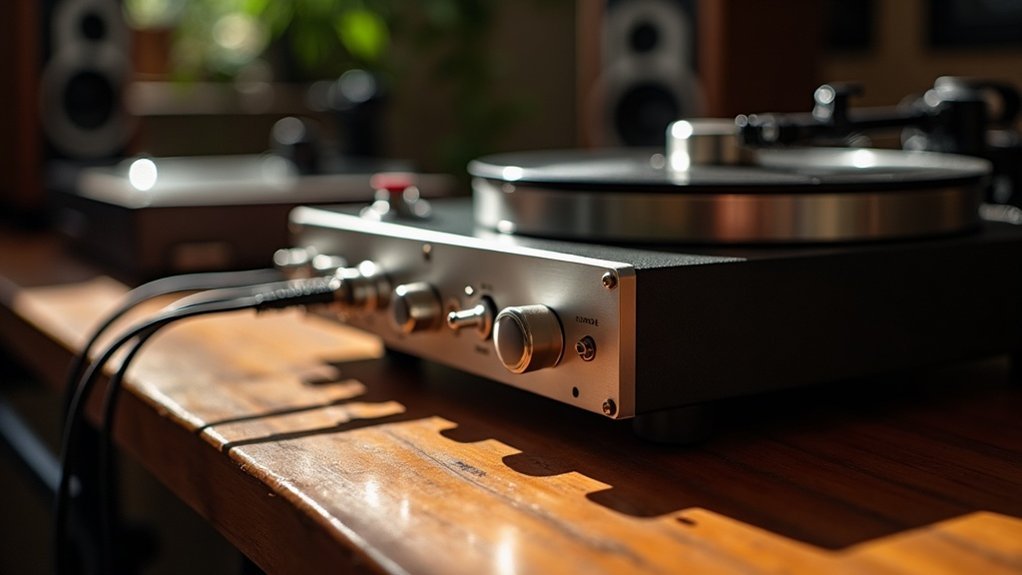
A preamp boosts weak audio signals to line level, ensuring proper impedance matching and minimizing noise. Understanding how a preamp works is crucial for creators, gamers, and musicians who want to elevate their audio quality. It elevates mic and instrument levels, maintaining clarity and dynamic range while preventing distortion. By efficiently converting signals and managing gain structure, a preamp enhances overall audio performance.
Additionally, a well-designed preamp contributes to noise control and frequency response, which are vital for optimal audio experiences in podcasting, streaming, gaming, and recording. Grasping how a preamp works allows users to make informed decisions about their audio setups. There’s much more to discover about the inner workings and functions of preamps, making it essential knowledge for anyone serious about sound quality.
Key Takeaways
- A preamp boosts weak input signals, such as those from microphones or instruments, to a standard line level for efficient processing.
- It ensures proper impedance matching, preventing signal loss and maintaining clarity between different audio devices.
- Preamps provide low-distortion amplification, preserving dynamic range and enhancing overall audio quality during recording and playback.
- They facilitate seamless integration across various audio equipment, ensuring compatibility and minimizing noise interference.
- Control functions, like source selection and monitoring features, improve usability and signal routing for optimized audio performance.
Why You Need a Preamp: Understanding Its Purpose?
Proper impedance matching is vital; it prevents signal loss and maintains high fidelity across various components. With low-distortion amplification, a preamp preserves dynamic range and channel balance, offering a richer listening experience. Moreover, the integration of audio interfaces into your setup can further streamline the recording process and enhance versatility. Recognizing *the purpose of a preamp* not only optimizes your setup but also elevates your audio enjoyment significantly. Investing in these essential components is crucial for creators, gamers, musicians, and professionals who seek to maximize their audio experience during podcasting, streaming, gaming, and recording.
Boosting Signal Strength With Preamps
Boosting signal strength is essential for achieving ideal audio quality in your recordings and live performances.
By elevating weak input signals to line level, preamps guarantee that your audio equipment operates efficiently without compromising clarity or detail. This process not only enhances the overall sound but also maintains the integrity of the original signal, minimizing noise and distortion. Additionally, the use of higher-end audio interfaces ensures superior preamps, further enhancing sound fidelity. This is particularly important for signal amplification, as it allows for optimal sound reproduction across various audio setups. An effective preamp can significantly impact the overall recording process, ensuring that every nuance of the sound is captured accurately.
Importance Of Signal Boosting
Although many audio signals start at low levels, the importance of signal boosting with preamps cannot be overstated. Signal boosting is crucial for transforming mic- and instrument-level signals to line level, which is vital for the optimal operation of audio interfaces and mixers. By effectively utilizing preamps, you can avoid signal distortion and ensure clarity and consistency in your recordings. Additionally, preamps serve as an interface between audio sources and power amplifiers, which enhances the overall sound quality. The use of gain control in preamps allows for precise adjustments, ensuring that the input signal is optimized for the best possible output. This process is vital because microphone gain directly influences the quality of the captured sound.
| Preamp Type | Gain (dB) | Use Case |
|---|---|---|
| Tube | 30-40 | Warmth in vocals |
| Solid-state | 20-60 | Clean, precise amplification |
| FET | 30-50 | Fast transient response |
| Class A | 40-60 | High fidelity recordings |
| Hybrid | 20-50 | Versatile applications |
The importance of signal boosting is essential for achieving high-quality audio. Emphasizing signal boosting through the right preamps can dramatically enhance your audio experience, whether you’re podcasting, streaming, or recording.
Effects On Audio Quality
As preamps play an essential role in audio signal processing, their effects on audio quality can’t be overlooked. Proper gain staging is vital for maintaining audio fidelity and ensuring peak performance. In fact, understanding microphone gain is fundamental to optimizing audio recordings.
The effects on audio quality include:
- Enhanced signal clarity through improved signal-to-noise ratio.
- Dynamic preservation, preventing clipping and reducing harmonic distortion.
- Effective bandwidth management, supporting a balanced frequency response.
When you boost signal strength appropriately, you achieve noise reduction while preserving tonal character. However, excessive gain can degrade clarity and introduce unwanted artifacts. Striking the right balance allows for a rich, detailed audio experience without compromising quality, significantly impacting the overall effects on audio quality. Maintaining dynamic range is essential to ensure that both quiet and loud sounds are represented accurately, enhancing the listening experience. Additionally, signal boosters can further improve preamp performance by amplifying weak signals before they reach the amplifier.
Understanding the effects on audio quality is crucial for creators, gamers, and musicians who rely on affordable microphones for podcasting, streaming, and recording.
The Role of Line-Level Conversion in Audio
Line-level conversion is essential for ensuring your audio signals maintain ideal strength and clarity as they move between devices. By standardizing operating levels, you prevent distortion and noise, allowing for efficient processing of weak signals. Understanding this role helps you achieve better sound quality in your audio setups, as line-level signals ensure compatibility across audio components, minimizing the risk of interference. This process is particularly crucial when using a DI box to reduce line level output and balance audio signals effectively. Additionally, maintaining line level standards is vital for achieving optimal signal integrity throughout your audio chain.
Importance of Signal Strength
Signal strength is essential in audio processing, particularly for creators, gamers, and musicians who rely on microphones for podcasting, streaming, and recording. Weak source outputs from microphones and instruments often fall below line level, increasing the risk of noise contamination. Proper preamp specifications and design are crucial to ensure that gain staging elevates these signals, enhancing both signal clarity and integrity.
- Secure appropriate input types to match impedance considerations, which is vital for maintaining optimal signal strength.
- Maintain ideal output levels to prevent distortion while maximizing audio dynamics, ensuring that your recordings capture the full range of your performance.
- Prioritize noise reduction techniques to improve the overall signal-to-noise ratio, thereby bolstering the importance of signal strength in your audio setup.
- Utilizing phantom power can also enhance the performance of condenser microphones, ensuring they operate effectively during recordings.
Standard Operating Levels
Achieving ideal audio quality requires understanding standard operating levels, particularly when it comes to line-level conversion. The primary line level differences are between professional (+4 dBu) and consumer (–10 dBV) standards.
Voltage matching is vital here, as the 11.8–12 dB difference can lead to under-driving if mismatched. Professional gear typically operates at approximately 1.23 V RMS, while consumer devices output around 0.316 V RMS.
Ensuring compatibility between these standard operating levels is essential for predictable headroom and noise performance, allowing seamless integration across mixers, processors, and amplifiers. Additionally, USB microphones often cater to consumer standards, making them popular for home recording setups.
Proper line-level conversion enhances audio integrity and overall system efficiency, ensuring that creators, gamers, and musicians can maximize their audio experience.
Understanding these operating levels not only contributes to better sound quality but also supports effective setups for podcasting, streaming, and recording.
Processing Weak Signals Efficiently
While weak audio signals from sources like microphones and pickups often struggle to maintain clarity, processing weak signals efficiently through effective line-level conversion plays a crucial role in overcoming these challenges.
- It enhances dynamic range, ensuring clarity and detail in your recordings.
- Proper gain structuring prevents overload and maintains headroom, which is essential for optimal audio performance.
- Efficient signal processing boosts signal integrity for downstream equipment, ultimately improving the overall quality of weak audio signals.
- Understanding the difference between mic level and line level is essential for effective audio signal management.
Why Noise Control Is Key for Your Preamp?
Noise control is key for your preamp because it directly influences the overall audio quality and the effectiveness of your recordings. By prioritizing noise control, you elevate your signal-to-noise ratio, ensuring that quiet sources and low-output microphones maintain clarity.
A well-designed preamp optimizes gain structure, preserving dynamic range without amplifying unwanted noise. In a dense mix, noise accumulation can mask subtle details, compromising your sound. By adhering to preamp specifications, you achieve cleaner recordings, enhancing micro-dynamics and preventing distortion.
Ultimately, effective noise control allows your acoustic environment to shine, making your recording techniques more impactful and immersive. Understanding why noise control is key for your preamp can significantly improve your recording experience, whether you’re podcasting, streaming, or creating music. Additionally, a higher signal to noise ratio ensures that your recordings capture nuances that would otherwise be lost in noise.
Understanding Impedance Matching for Clear Signals
Understanding impedance matching for clear signals is essential for ensuring optimal audio performance in your systems. This concept directly impacts the performance of your preamp and connected devices.
By mastering the principles of impedance matching, you can facilitate:
- Clean transfer of voltage, which is crucial for clear signals
- Accurate frequency response, enhancing the overall listening experience
- Reduced signal distortion, allowing for pristine sound quality
Incorporating proper impedance relationships significantly improves your setup, ensuring that creators, gamers, and musicians can achieve the highest fidelity in their recordings and streams. Additionally, understanding balanced vs. unbalanced connections can further enhance signal integrity and minimize noise in your audio setup.
Understanding impedance matching for clear signals not only benefits audio quality but also helps you get the most out of your affordable microphones and audio equipment.
Control Functions in Preamps: Source Selection and More
Control Functions in Preamps: Source Selection and More are essential for enhancing your audio experience. Effective source selection and routing ensure the right input signal reaches your power amplifier, positioning your preamp as a pivotal audio hub.
User interfaces—such as rotary selectors and digital menus—facilitate this process, making it more intuitive. With a variety of input options, including analog RCA and balanced XLR, your system can maintain output consistency across different formats.
When considering Control Functions in Preamps, it’s noteworthy that switching methods commonly utilize mechanical or electronic relays, while monitoring features like record buses improve usability.
Maintaining Signal Integrity in Preamp Circuits
To maintain signal integrity in preamp circuits, careful design choices are essential. Focusing on optimizing the input stage and employing effective grounding techniques is crucial to minimize noise and crosstalk.
Maintaining signal integrity in preamp circuits requires careful design choices, particularly in optimizing the input stage and grounding techniques.
Maintaining signal integrity in preamp circuits involves several key strategies:
- Use low-noise active devices for effective noise reduction.
- Implement layout optimization for short, direct signal paths to enhance clarity.
- Guarantee power integrity with well-filtered power supplies, ensuring that the entire system supports high fidelity.