
A transient in audio is a sharp spike at the onset of a sound event, vital for clarity and definition. Understanding what a transient in audio is can significantly enhance your productions. These brief, powerful moments typically occur within milliseconds, influencing perceived loudness and allowing listeners to distinguish between different sounds. Transients also shape the rhythmic structure of music, making timing essential for effective mixes.
Managing transients effectively—those crucial audio spikes—enhances your mix’s impact, ensuring that your podcasting, streaming, or gaming audio stands out. Recognizing the role of transients in audio can elevate your audio production, leading to more professional outcomes that keep listeners engaged. By mastering the concept of transients in audio, you can create a more dynamic and captivating listening experience.
Key Takeaways
- Transients are sharp spikes in audio waveforms that mark the onset of sound events, crucial for clarity and definition in mixes.
- They have fast rise times and rich harmonic content, occurring within milliseconds, influencing perceived loudness and realism.
- Strong transients enhance punch and aid in sound recognition and spatial localization, shaping rhythmic structure in music.
- Managing transients through dynamic processing techniques like compression and transient shaping is essential for maintaining audio clarity.
- Effective transient management ensures impactful sound while avoiding common pitfalls like over-processing and timing errors.
What Are Transients in Audio and Why Are They Important?
What Are Transients in Audio and Why Are They Important?
Transients in audio are critical elements that define the onset of sound events, acting as the sharp spikes in waveforms that grab your attention. Understanding transients in audio and why they’re important is essential for anyone looking to enhance their recordings. Their transient characteristics include extremely fast rise times and rich harmonic content, typically occurring within milliseconds.
Recognizing the significance of these transients is fundamental for achieving clarity and definition in your mixes; they help distinguish individual sounds in complex arrangements. Transients serve as timing markers, shaping rhythm and articulation, which are vital for creating a cohesive musical experience. Defined transients also enhance energy and drive in music, ensuring that each sound maintains its impact. Additionally, the transient response of a system can greatly affect how accurately these sounds are reproduced, making it an essential aspect of sound engineering.
Ultimately, they influence perceived loudness and realism, giving sounds their distinctive snap and impact—crucial elements for professional-quality recordings. By mastering the intricacies of transients in audio, creators and musicians can elevate their sound to new heights. Understanding why transients are important not only enhances your mixing skills but also ensures that your recordings stand out in a competitive landscape.
How Transients Influence Sound Perception and Mixing
Understanding how transients influence sound perception and mixing is crucial for achieving optimal audio quality. Recognizing the role of transients extends beyond their definition; it directly impacts how you perceive sound and mix tracks effectively.
- Strong transients enhance perceived loudness and punch, making your audio stand out.
- Unique characteristics of these transients aid in sound recognition and spatial localization, allowing listeners to identify different elements in a mix.
- The precise timing of transients shapes the rhythmic structure, which is vital in crafting engaging music or podcasts. Transients occur during the attack phase of a sound, making them essential for capturing the initial impact of audio. Additionally, the enhancement of auditory transients in the auditory periphery improves overall sound clarity.
- Effective mixing techniques that consider how transients influence sound perception and mixing balance these elements to maintain audio clarity.
- Dynamic range management ensures that strong transients don’t compromise overall loudness, thereby preserving the integrity of your sound.
What Do Transients Sound Like in Everyday Life?
One mightn’t realize how prevalent transients sound like in everyday life, but they play a significant role in shaping our auditory experiences.
Examples of transients include knocks on doors, clinking cutlery, and dropping keys, all characterized by rapid onset and minimal decay. In speech, stop consonants like [p] and [t] generate identifiable transients before vowels, enhancing clarity. Additionally, the explosive release of closures in speech creates sharp bursts that are critical for articulation. This is similar to how transient emphasis can create a wider soundstage in music.
Transients like door knocks and stop consonants enhance clarity, shaping our auditory experiences with their rapid onset and minimal decay.
Common occurrences also feature mechanical sounds from switches or passing vehicles, each producing distinct transient identification. These brief, high-amplitude bursts contribute to our understanding of sounds, allowing us to perceive nuances in our environment.
Recognizing how transients sound like in daily activities enriches our appreciation of the auditory landscape around us, helping creators, musicians, and professionals leverage sound details effectively in their work.
Effective Techniques for Shaping and Managing Audio Transients

When shaping and managing audio transients, understanding dynamic processing is essential. You’ll want to employ techniques like compression and transient shaping to control the initial peaks while preserving the sound’s integrity. Utilizing transient shaping can significantly enhance the punch and clarity of your tracks. Incorporating key parameters such as attack and sustain control can further refine your sound design. A properly set noise gate can also help manage unwanted audio noise during quieter sections, ensuring your transients remain clear and impactful.
Transient Shaping Techniques
Effective transient shaping techniques are essential for sculpting dynamic audio elements, ensuring clarity and impact in a mix. By implementing these transient shaping techniques, you can significantly enhance your sound:
- Multiband processing strategies to target low-frequency transients, tightening kicks and bass for a more polished result.
- Attack adjustments that boost definition and punch in dull transients, elevating the overall presence in your mix.
- Sustain control for extending or shortening decay, allowing you to tailor the mix to your unique style. This is particularly important because transients represent the envelope of an audio source, influencing how each sound is perceived. Additionally, understanding how transients contain non-periodic components can help you make more informed decisions when shaping your audio.
- Parallel processing for separate transient control, which helps maintain clarity while emphasizing the desired effects.
- Upward expansion to exaggerate attacks while preserving sustain, offering a more dynamic listening experience.
Incorporating these transient shaping techniques into your workflow can transform your audio projects, making them more engaging and professional.
Dynamics Processing Essentials
Dynamics processing essentials play a crucial role in expertly shaping and managing audio transients. By effectively controlling the peaks and valleys of sound, you can achieve precision in your mixes. Techniques such as compression, limiting, expansion, and gating are fundamental to mastering dynamics processing essentials.
Adjusting attack and release times helps preserve punch while managing peak levels, ensuring your audio remains dynamic and engaging.
Employing brickwall limiting is vital in preventing digital clipping, allowing for clarity without sacrificing loudness—a key component of dynamics processing essentials. Limiters in audio help maintain a consistent sound level, ensuring no unwanted distortion occurs during playback.
Meanwhile, using multiband compression enables targeted adjustments across different frequency ranges, enhancing mix translation and making your audio sound polished across various playback systems.
Ultimately, mastering these dynamics processing essentials will elevate your audio, providing impactful sound that resonates well in any context—whether for podcasting, streaming, gaming, or recording.
Tools for Detecting and Editing Audio Transients
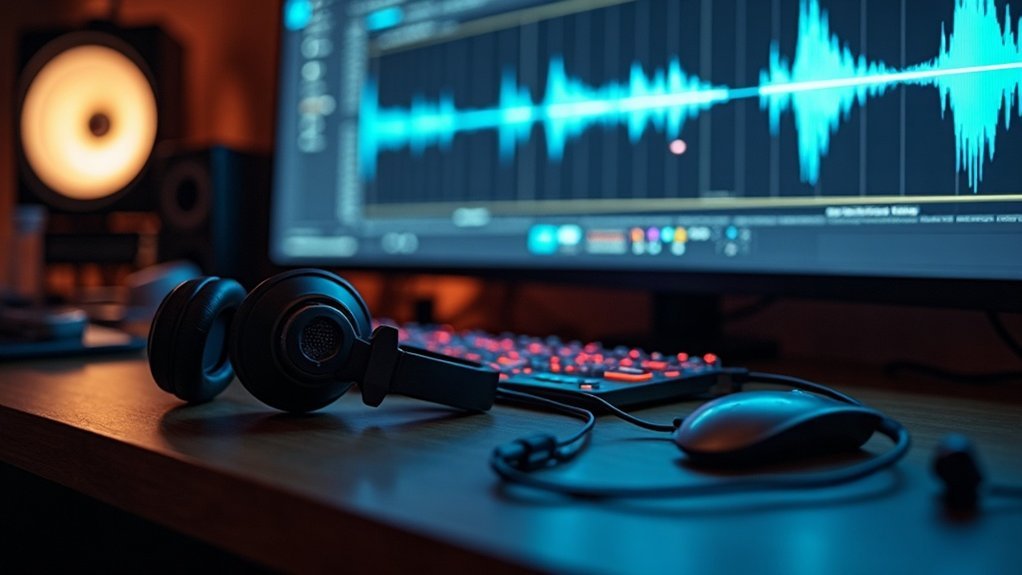
To accurately detect and edit audio transients, you’ll find a variety of specialized tools for detecting and editing audio transients designed for both analysis and manipulation:
- Aubio: An open-source library that excels in transient detection and audio slicing.
- Essentia: Provides robust onset detection algorithms tailored for identifying transients.
- Wolfram Language: Includes built-in functions specifically for pinpointing transient events.
- Fraunhofer Algorithm: Utilizes Short-Time Fourier Transform (STFT) for reliable transient detection.
- Ableton Live: Streamlines the process by automating transient detection and slicing, enhancing your workflow.
These tools are essential for performing precise transient detection, enabling effective audio slicing while preserving the integrity of your sound design.
Essential tools for precise transient detection enhance audio slicing and maintain the integrity of your sound design.
By incorporating these tools into your workflow, you can significantly refine your audio projects and optimize your creative processes.
Embrace specialized instruments for detecting and editing audio transients to elevate your work.
Common Mistakes to Avoid When Working With Transients in Audio
While working with transients in audio can elevate your productions, several common mistakes to avoid when working with transients in audio can undermine your efforts.
Transient misjudgment, such as setting inappropriate compressor attack and release times, leads to compression pitfalls that dull your mixes. Timing errors and phase issues can weaken clarity, while over-processing risks stripping dynamic preservation.
Prioritize editing strategies that maintain groove, steering clear of excessive quantization that feels robotic. Remember, relying solely on visual meters can mask transient integrity.
Instead, trust your ears to catch discrepancies, ensuring your transients remain punchy and impactful. By sidestepping these common mistakes, you’ll keep your sound vibrant and engaging while effectively managing transients in audio.