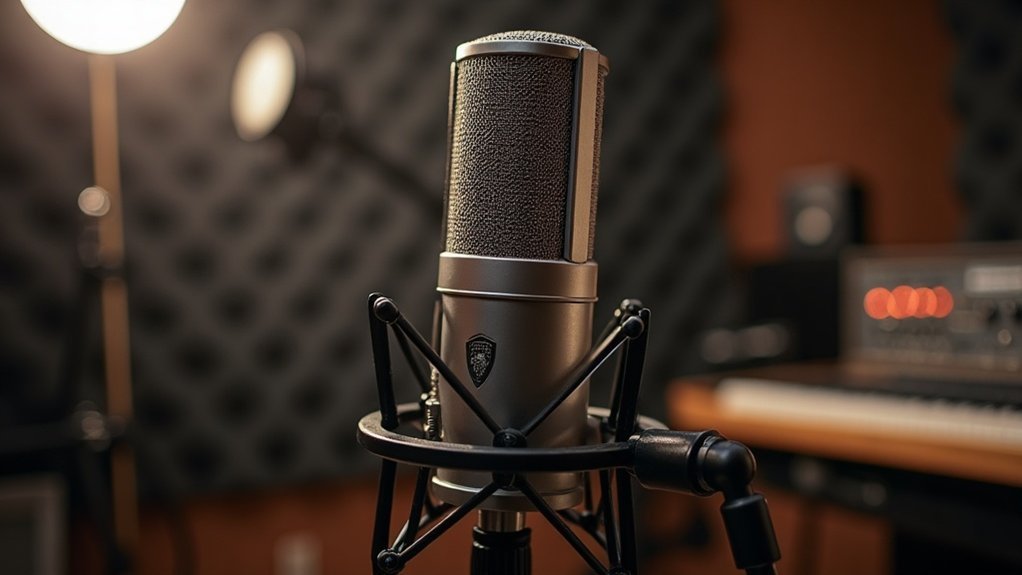

A contact microphone captures sound by detecting vibrations from solid objects and converts these mechanical movements into electrical signals using piezoelectricity. This type of microphone is particularly ideal for musical instrument amplification due to its high noise immunity and ability to isolate sound from ambient noise. By focusing on internal vibrations, a contact microphone reveals unique sonic characteristics that traditional mics often miss. As you explore the world of contact microphones, you’ll discover effective setup guidelines and innovative applications that can maximize its potential, particularly in podcasting, streaming, and recording contexts. Understanding how to leverage the capabilities of a contact microphone can enhance your audio projects, making it a valuable tool for creators, musicians, and professionals alike.
Key Takeaways
- A contact microphone captures sound by sensing vibrations from solid objects through piezoelectricity, converting them into electrical signals.
- It provides high sound isolation, making it ideal for amplifying musical instruments and minimizing ambient noise.
- Commonly used in innovative recording techniques, it reveals unique sonic perspectives often overlooked by traditional microphones.
- Proper mounting techniques and connections are crucial for optimal performance, including using shielded cables and avoiding phantom power for passive models.
- Applications range from amplifying instruments to capturing detailed sounds in Foley recording, expanding creative sound exploration possibilities.
What Is a Contact Microphone?
A contact microphone is a specialized audio transducer that captures sound by sensing vibrations directly from solid objects rather than through air pressure changes. This unique technology employs piezoelectricity, converting material-borne vibrations into electrical signals.
Due to its design, a contact microphone excels at vibration detection, making it nearly insensitive to airborne sounds and achieving impressive sound isolation. By attaching a piezoelectric ceramic element to a metal disk, it effectively picks up internal resonances and subtle details within various materials. This capability is particularly beneficial for applications like musical instrument amplification, where capturing intricate vibrations is essential. In fact, contact microphones rely on piezoelectric ceramics to generate tiny voltage when mechanically stressed.
The audio captured by a contact microphone can be amplified or recorded, offering a distinctive sonic perspective that highlights mechanical nuances often overlooked by traditional microphones.
For creators, musicians, and professionals, understanding how to utilize a contact microphone can enhance your recordings and provide a fresh approach to sound capture.
How to Set Up a Contact Microphone Effectively
Setting up a contact microphone effectively requires careful attention to detail to guarantee ideal sound capture. To begin, connect the mic to a high-impedance input. Employ proper mounting techniques such as adhesive tape or a gentle clamp to secure it firmly. This prevents movement and enhances vibration transfer, which is crucial when setting up a contact microphone effectively. Additionally, ensure connections are insulated carefully, avoiding phantom power for passive models. If you find the output seems weak, optimizing signal amplification with a preamp can significantly improve performance. Incorporating piezo elements into your setup can further enhance the microphone’s ability to capture vibrations accurately. To achieve this, consider using a 500kOhm potentiometer to adjust the filter settings for improved sound quality. To validate your setup, test it by tapping the mic or the surface it’s mounted on, confirming a strong signal before field use. Remember that different materials yield unique tonal responses, so be sure to choose your mounting surface wisely when you’re focused on how to set up a contact microphone effectively.
Key Components of Contact Microphones
Contact microphones consist of several key components that work together to capture sound effectively. Understanding the key components of contact microphones is essential for creators, gamers, musicians, and professionals looking to enhance their audio experience. The primary transducer type is the piezoelectric element, typically a piezo disc that converts vibrations into electrical signals. Various mounting techniques are employed, using adhesives like silicone or clamps for secure attachment to ensure optimal performance. Additionally, contact microphones can be used as sensors, allowing them to send data to computers or microcontrollers. The resonant frequency of the piezoelectric element significantly influences the microphone’s sound output.
| Component | Function | Material Type |
|---|---|---|
| Transducer Type | Converts vibration to electrical signal | Piezoelectric element |
| Mounting Techniques | Attaches mic to vibrating surfaces | Adhesives, clamps |
| Electrical Contacts | Guarantees clean signal transfer | Metal, ceramic |
| Cable System | Reduces noise in signal path | Shielded cables |
Benefits of Contact Microphones

Contact microphones offer significant benefits, particularly in high-noise environments where their structure-borne sound capture provides remarkable noise immunity. You’ll appreciate the unique sonic perspectives they reveal, allowing access to internal vibrations and subtleties often missed by traditional mics. Additionally, they enable exploration of uncharted auditory territories, revealing sounds often hidden from untrained ears. Plus, their straightforward DIY applications make them accessible for various creative projects, enhancing your audio toolkit. Their ability to convert mechanical vibrations ensures that you can capture sound with clarity, even in challenging conditions.
High Noise Immunity
While many microphones struggle with background noise, contact microphones stand out for their remarkable high noise immunity, capturing clear sound even in the loudest environments. Their design leverages advanced noise isolation techniques, focusing on structure-borne sound to minimize interference from ambient noise. By directly coupling to surfaces, you achieve exceptional rejection of airborne disturbances, significantly enhancing signal quality. Recent advancements in vibration sensing further refine this process, improving signal-to-noise ratios in noisy settings like industrial sites or motorsport arenas. Additionally, these microphones can be particularly useful in 404-error situations where clarity is crucial for effective communication. Whether you’re monitoring communications or recording instruments, contact mics with high noise immunity guarantee intelligibility and clarity. These microphones are invaluable tools in extreme conditions where traditional options falter, making them ideal for creators, gamers, and musicians seeking reliable performance.
Unique Sonic Perspectives
Though traditional microphones capture sound from the air, unique Sonic perspectives emerge when we explore contact microphones. These innovative tools access structure-borne vibrations within materials, unveiling a world of distinct auditory experiences.
This sonic exploration reveals hidden internal resonances, offering a deeper understanding of sound through:
- Micro-vibrations in various materials, transforming everyday objects into rich sound sources, aligning perfectly with unique Sonic perspectives.
- Intimate, close-up views that minimize ambient noise, enhancing detail and clarity—a hallmark of unique sonic perspectives.
- Non-standard recording locations that conventional mics can’t reach, further expanding the boundaries of unique sonic perspectives.
Easy DIY Applications
Exploring easy DIY applications of contact microphones reveals a world of sound experimentation that’s both accessible and engaging. These versatile mics allow you to amplify everyday objects, creating unique DIY soundscapes. Here’s a quick look at some applications that highlight the potential of easy DIY contact mic projects:
| Application | Description |
|---|---|
| Household Objects | Capture vibrations from cups or furniture. |
| Instrument Electrification | Amplify guitars or drums with minimal modifications. |
| Foley Recording | Record detailed sounds from props. |
| Real-time Monitoring | Use amplifiers for immediate feedback. |
| Educational Projects | Build mics for hands-on STEM learning. |
Dive into the realm of easy DIY applications of contact microphones and unleash your creativity through everyday resonance! Whether you’re a musician, a gamer, or simply a sound enthusiast, these projects are perfect for exploring sound in innovative ways.
Where to Use Contact Microphones Effectively
Contact microphones excel in a variety of applications, offering unique advantages in both musical and environmental contexts. When considering *where to use contact microphones effectively*, you can leverage their capabilities in:
Contact microphones offer unique advantages for capturing rich sound in both musical performances and environmental recordings.
- Performance settings: Attach them to acoustic instruments for rich resonance capture without room noise, enhancing your live sound experience.
- Field recordings: Mount them on surfaces to isolate vibrations, making them perfect for capturing subtle environmental sounds that traditional mics might miss.
- Creative applications: Explore unconventional materials and props to generate experimental sounds, which can significantly enhance your sound manipulation skills.
These innovative uses foster artistic exploration and acoustic experimentation, allowing you to discover new textures and sonic landscapes in your projects.
Troubleshooting Contact Microphones
When troubleshooting contact microphones, you’ll often encounter issues like impedance mismatches and inadequate coupling that affect signal quality.
To optimize your setup, guarantee proper buffering and use high-impedance inputs for the best performance.
Addressing these common problems can greatly enhance your recording experience.
Common Issues Encountered
Although troubleshooting contact microphones can seem intimidating, understanding common issues encountered with these devices can greatly enhance your recording experience. You might face:
- Impedance mismatch, leading to weak signals and degraded tone.
- Noise interference, from electromagnetic fields or handling noise, affecting signal integrity.
- Mechanical fragility, as some piezo elements can crack or delaminate.
Addressing these common issues encountered with contact microphones involves ensuring proper electrical shielding, ideal mounting techniques for surface compatibility, and being mindful of frequency response variations.
Optimal Setup Tips
To achieve ideal performance from your contact microphone, following optimal setup tips is essential. Start by using clean, flat, rigid surfaces to maximize mechanical coupling, ensuring the mic’s flat face is placed directly against the vibrating object.
Implement effective mounting techniques, such as electrical tape or clamps, to avoid any residue. Engage in vibration testing by feeling for strong vibrations with your fingertip to identify useful positions, particularly near nodal points on resonant objects.
Gradually adjust gain while monitoring to prevent distortion, and make incremental movements to fine-tune timbre. This meticulous approach not only guarantees clarity but also minimizes unwanted noise in your recordings, aligning perfectly with optimal setup tips for achieving the best sound quality.
How Do Contact Microphones Stack Up Against Traditional Ones?
While both contact microphones and traditional ones serve the purpose of sound capture, their fundamental operating principles lead to distinct differences in their applications and output characteristics.
Contact microphones excel in isolating structure-borne vibrations, offering unique sound characteristics that set them apart. In contrast, traditional microphones provide a natural timbre enhanced by room acoustics, making them ideal for full-range recordings.
Contact microphones isolate vibrations for unique sounds, while traditional mics capture natural timbre enhanced by room acoustics.
When considering how contact microphones stack up against traditional ones, your choice should hinge on comparison metrics like frequency response and environmental handling.
Ultimately, understanding these differences guarantees you select the right tool for your creative needs, whether you’re after experimental textures with contact mics or lifelike reproductions with traditional options in various settings.
Tips for Maximizing Your Contact Microphone’s Performance

Maximizing your contact microphone’s performance hinges on careful placement and coupling with the sound source. To truly excel in maximizing your contact microphone’s performance, employ precise placement techniques near nodal points for clearer recordings.
Utilize vibration sensitivity tests to identify ideal surfaces that enhance sound capture. Experiment with various mounting options, such as removable poster adhesive or non-resonant clips, ensuring solid contact without excessive damping, which is crucial for getting the most out of your contact microphone.
To further improve your recordings, enhance signal integrity by incorporating a high-impedance buffer preamp. This will significantly improve frequency response, contributing to better overall sound quality.
Engage in performance experimentation to explore different objects and excitation methods, as these directly affect object resonance and tonal richness. By actively monitoring in real-time, you can fine-tune placements and avoid unwanted distortion, effectively maximizing your contact microphone’s performance during recordings.