
Frequency response measures how audio systems output sound across varied frequencies, directly impacting clarity and tonal balance. Understanding frequency response is essential for ensuring that amplifiers, microphones, and loudspeakers reproduce audio accurately within the 20 Hz to 20 kHz range. A flat frequency response minimizes coloration, maintaining balanced bass, mids, and highs, which significantly enhances your listening experience. By grasping the concept of how frequency response impacts audio quality**, you can make informed choices for your podcasting, streaming, or recording needs. Explore further to uncover additional insights about its applications and measurement techniques**, and discover how mastering frequency response can elevate your audio performance.
Key Takeaways
- Frequency response measures how a system outputs sound across different frequencies, influencing audio quality and tonal balance.
- A flat frequency response indicates even reproduction without frequency bias, enhancing clarity and realism in sound.
- Magnitude response reflects gain or attenuation, while phase response reveals potential distortions affecting audio clarity.
- Various measurement methods, such as stepped sine and continuous sweep, assess frequency response for accurate audio reproduction.
- In engineering, frequency response is vital for filter design, stability analysis, and optimizing signal integrity in audio applications.
Understanding Frequency Response: Its Importance in Audio and Engineering
When you analyze frequency response, you’re fundamentally measuring how a system outputs sound across various frequencies, which is critical for both audio and engineering applications. A thorough understanding of mic level vs. line level helps in determining how these signals interact with frequency response in an audio system.
Understanding frequency response is essential for ensuring accurate audio reproduction techniques, as it directly influences tonal balance and clarity. The applications of a system’s frequency response encompass amplifiers, microphones, and loudspeakers, affecting how evenly sound is reproduced within the 20 Hz–20 kHz range. By evaluating output levels over this spectrum, you can identify deviations that may lead to coloration, ensuring high-fidelity sound reproduction. A flat response indicates even reproduction without frequency bias, making it crucial for equipment selection.
Understanding frequency response is vital for achieving tonal balance and clarity in audio reproduction across amplifiers, microphones, and loudspeakers.
Mastering frequency response not only enhances your audio experience but also optimizes system performance, making it crucial for creators, gamers, musicians, and professionals. Additionally, knowing the ideal audio devices exhibit a “flat response” helps in selecting equipment that provides the most accurate sound reproduction.
Whether you’re choosing a microphone for podcasting or streaming, understanding how frequency response impacts sound quality can help you select the right equipment for your needs. Ultimately, a thorough grasp of frequency response and its implications will lead to better audio setups and more engaging content.
Magnitude and Phase Response Explained
Understanding magnitude and phase response is essential for analyzing how a system processes signals across different frequencies, particularly when it comes to audio applications like podcasting and streaming.
The magnitude response indicates gain or attenuation through magnitude scaling, reflecting filter characteristics and bandwidth limitations crucial for audio clarity. Conversely, the phase response reveals phase distortion and frequency specificity, which are critical for maintaining response linearity in recordings. Additionally, cutoff frequency plays a pivotal role in determining which audio signals are allowed to pass through, impacting overall sound quality. The transfer function is a fundamental concept in characterizing these responses, as it describes how the system behaves in the frequency domain.
Transient response depends on consistent phase shifts across frequencies, ensuring minimal distortion—an important factor when selecting microphones for music or gaming.
When examining amplitude modulation, harmonic analysis becomes vital, as varying phase shifts can significantly impact audio output.
Therefore, both magnitude and phase are integral to understanding a system’s performance, especially regarding gain bandwidth and overall signal integrity. This understanding helps creators and professionals choose the right equipment to optimize their audio experiences.
Frequency Response in Audio Equipment: What You Need to Know
Understanding frequency response in audio equipment is essential for achieving accurate sound reproduction. A flat response guarantees that all frequencies are represented evenly, which directly impacts the clarity and character of the audio you hear. This is particularly important because higher-quality equipment achieves a flatter frequency response with minimal variation, enhancing the overall listening experience. Devices that aim for a “flat” frequency response ensure transparency and fidelity in sound playback.
Importance Of Flat Response
Flat frequency response is essential for accurate sound reproduction, ensuring that all audible frequencies are presented equally when input levels are consistent. The importance of flat response can’t be overstated, as it significantly enhances your listening experience. Additionally, a low noise floor is important to minimize unwanted sounds that can interfere with the clarity of the audio.
Here’s how embracing a flat response benefits you:
- Minimizing coloration and ensuring realism in sound
- Maintaining balanced bass, mids, and highs for an authentic audio experience
- Supporting long-term listening comfort, allowing for extended sessions without fatigue
- Providing a neutral reference for mixing and monitoring, crucial for creators and professionals
- Facilitating consistent playback across various systems, ensuring your audio translates well no matter the setup
Understanding the importance of flat response is key for musicians, gamers, and podcasters alike, as it allows for a more precise and enjoyable listening experience. Additionally, achieving a flat response reflects system performance and plays a vital role in enhancing the overall audio quality. This flat response is crucial because non-flat responses can significantly alter music perception, leading to a less authentic sound experience.
Frequency Response Measurement Methods
When measuring frequency response measurement methods in audio equipment, employing various techniques becomes essential to obtain accurate and reliable data. You can use stepped sine or continuous sweep methods to gather detailed output levels across frequencies. The multitone approach captures non-linear distortions, while broadband methods excite multiple frequencies simultaneously, allowing for efficient analysis via FFT. Impulse response measurements, paired with Fourier transforms, yield precise insights into magnitude and phase. Additionally, frequency response measurement techniques can also assess round-trip latency through audio drivers. Furthermore, noise signals can enhance frequency-response estimation, especially over longer periods. Each of these frequency response measurement techniques offers unique advantages, enabling you to tailor your approach for specific audio systems and testing environments. Understanding frequency response is crucial for achieving optimal sound quality in any audio device.
Impact On Sound Quality
Frequency response plays a pivotal role in determining the overall sound quality of audio equipment, making it crucial for creators, gamers, and musicians alike. It directly influences your sound perception and tonal balance, significantly affecting how you experience music.
Key factors include:
- Bass impact for weight and immersion, enhancing the audio experience
- Midrange clarity for vocal and instrument definition, vital for podcasting and streaming
- Treble detail for high-frequency richness, which enriches recordings and performances
- Frequency coloration affecting tonal accuracy, essential for accurate sound reproduction
- Acoustic accuracy ensuring faithful sound reproduction that meets professional standards
A flat frequency response enhances audio fidelity, making it particularly important for those in the creative fields. Additionally, a wide dynamic range in audio recording can improve the overall clarity and depth of sound, leading to a more immersive experience.
Imbalances can distort listener preference and diminish the overall sound quality. Understanding these elements of sound quality helps you appreciate the nuances that contribute to your overall audio experience, whether you’re gaming, recording, or enjoying music.
How Frequency Response Works in Engineering Applications
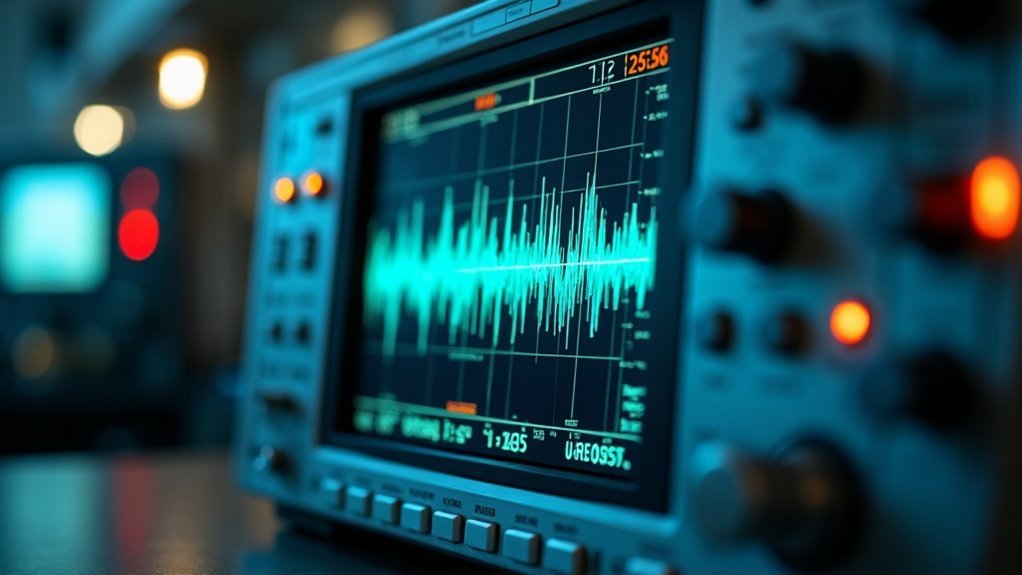
In engineering applications, understanding frequency response is essential for effective filter design, stability analysis, and signal processing.
You’ll analyze how filter characteristics, such as passbands and roll-off, impact system performance while evaluating stability margins to guarantee robust control.
Filter Design Considerations
While designing filters, particularly in the context of filter design considerations, you must consider several vital specifications to guarantee peak performance in engineering applications.
Key factors include:
- Filter order: Determines complexity and performance.
- Transition width: Affects required filter order and design feasibility.
- Passband ripple: Influences the flatness of the magnitude response.
- Stopband attenuation: Essential for rejecting unwanted signals.
- Implementation cost: Balances performance against budget constraints.
Choosing the right filter types—low-pass, high-pass, band-pass, or band-stop—also depends on your specific application needs.
In the realm of filter design considerations, optimizing these parameters is essential for achieving the desired phase response and overall filter efficacy.
Stability Analysis Techniques
You’ll employ the Nyquist theorem to assess stability criteria by analyzing the frequency response function, which is vital for achieving clear and consistent sound quality in podcasting and streaming.
Observe gain margins and phase margins to maintain relative stability; larger margins indicate a more resilient system, ensuring that your audio remains free from distortion. Pay attention to the damping ratio and resonance peaks, as these factors reveal system dynamics and potential oscillations that can affect your recordings.
By plotting the open-loop transfer function, you can determine loop gain ranges that secure stability, avoiding encirclements of the critical point (-1+j0). This analytical approach to stability analysis techniques helps safeguard against instability in complex engineering designs, ultimately enhancing the performance of affordable microphones and audio equipment. Additionally, understanding microphone gain is critical for achieving optimal audio levels in your recordings.
Signal Processing Applications
Stability analysis techniques set the stage for effective signal processing applications, where frequency response plays a pivotal role in engineering solutions. Understanding frequency response is essential in various contexts related to audio devices and communication systems:
- Noise shaping enhances signal integrity, crucial for high-quality audio recording.
- Equalization techniques mitigate signal distortion, ensuring clarity in podcasts and streams.
- Filter performance directly impacts audio fidelity, making it a key factor for musicians and gamers alike.
- Channel compensation improves overall transmission quality, vital for seamless communication.
- Spectral efficiency is optimized through careful frequency analysis, which is particularly important in streaming applications.
Incorporating these principles into your designs guarantees robust solutions, whether you’re working with affordable microphones for podcasting, streaming, gaming, or recording.
Mastering frequency response not only boosts performance but also fosters a sense of belonging in the engineering community, enhancing your ability to create exceptional content. Additionally, understanding signal to noise ratio is crucial for achieving optimal audio quality in any recording or transmission scenario.
Measuring Frequency Response: Techniques and Tools
Measuring Frequency Response: Techniques and Tools is essential for understanding how audio systems perform across different frequencies. Various techniques and tools are employed, each tailored to specific system characteristics and testing requirements. Here’s a quick overview:
| Technique | Description |
|---|---|
| Single Tone Techniques | Excite the system with one sine wave at a time. |
| Continuous Sweep | Produces a sine wave with varying frequencies. |
| Multitone Signals | Multiple tones applied for rapid frequency analysis. |
In the context of measuring frequency response, utilizing stepped sine methods, chirp techniques, and impulse methods allows for thorough assessments. Incorporating broadband noise can enhance the measurement efficacy, while precise measurement instrumentation ensures reliable results. Each method has its trade-offs, so it’s crucial to select according to your system’s needs. Understanding the nuances of these measurement techniques is vital for creators, gamers, musicians, and professionals seeking to optimize their audio setups.
Interpreting Frequency Response Curves and Bode Plots
After exploring various techniques for measuring frequency response curves and Bode plots, it’s important to interpret the resulting data effectively.
Key aspects to analyze include:
Key aspects to analyze include peak identification, tilt analysis, curve smoothing, off-axis evaluation, and frequency roll-off.
- Peak identification for tonal coloration, which can significantly impact the overall sound quality.
- Tilt analysis to determine bass extension or treble focus, helping you understand how frequency response curves influence audio balance.
- Curve smoothing that impacts resonance detection, a crucial factor when interpreting Bode plots.
- Off-axis evaluation for in-room performance, ensuring that your microphones deliver consistent results regardless of the listener’s position.
- Frequency roll-off indicating low-end capabilities, essential for assessing the dynamic range in your recordings.