
What Is dBFS?
dBFS, or decibels relative to full scale, is an essential concept in digital audio systems, measuring amplitude in a way that helps creators, musicians, and gamers understand their sound levels. In this context, 0 dBFS represents the maximum level to avoid distortion and clipping, making it a critical metric for ensuring ideal recording conditions.
By mastering what dBFS means, you can effectively manage gain staging and maintain audio clarity in your projects. Keeping levels below 0 dBFS is crucial for preserving your dynamic range and sound quality, which is especially important in podcasting and streaming.
Understanding dBFS not only aids in achieving optimal recordings but also allows for better comparisons with other measurement units in audio production. Dive deeper into its practical applications to enhance your audio setup and ensure you’re getting the most out of your affordable microphones.
Key Takeaways
- dBFS stands for decibels relative to full scale, indicating amplitude levels in digital audio systems.
- 0 dBFS is the maximum digital level, serving as the ceiling to prevent clipping distortion.
- It quantifies audio amplitude against the system’s full-scale reference, not measuring loudness.
- Common practice is to maintain levels below 0 dBFS to preserve clarity and dynamic range.
- Understanding dBFS is essential for effective gain staging and managing headroom in audio production.
What Is dBFS? Understanding the Basics
Understanding dBFS is vital for anyone working with digital audio systems, especially creators, gamers, and musicians. dBFS, short for decibels relative to full scale, expresses amplitude levels in these systems, where 0 dBFS represents the maximum possible digital level.
The history of dBFS shows its evolution as an important reference for various audio applications, including podcasting and streaming. Common misconceptions include confusing dBFS with loudness measurements; however, its significance lies in providing a consistent framework for calculations. This is essential for ensuring efficient gain staging while avoiding overload in your recordings. Additionally, 0 dBFS is assigned to the RMS of a sine wave, which clarifies its relationship to maximum digital amplitude. Accurate design of digital-to-analog converters can further help prevent clipping during playback.
Although dBFS has limitations, such as being system-specific, its visualizations help you grasp signal levels effectively, making it indispensable in digital audio workflows.
Understanding dBFS is crucial for anyone looking to maximize their audio quality and achieve the best results in their projects. Whether you’re a musician or a gamer, a solid grasp of dBFS and its implications can elevate your audio experience significantly.
How Is dBFS Measured in Digital Audio?
Measuring dBFS in digital audio involves quantifying amplitude levels relative to the system’s full-scale reference. To effectively measure dBFS in digital audio, you can employ various techniques, such as peak and RMS methods, to assess audio levels accurately. The core formula (L_{dBFS} = 20 cdot log_{10}(|x| / x_{FS})) is essential for calculating levels against full-scale amplitude. According to digital audio standards, 0 dBFS is defined as the maximum representable value, typically represented by the largest binary word in PCM formats. Understanding how dBFS is measured in digital audio ensures that you effectively manage audio dynamics, optimize headroom, and maintain clarity in your projects. This knowledge fosters a sense of belonging within the audio community, whether you’re a creator, gamer, or musician looking to enhance your sound quality. Additionally, being aware of dynamic range and its impact on loudness can further refine your audio processing techniques. A deeper understanding of quantization in digital audio helps clarify how signal representation affects overall sound quality. Maintaining a low noise floor is also crucial, as it directly influences the perceived clarity and detail in your recordings.
Why Does 0 dBFS Matter: Clipping Risks?
Zero dBFS serves as the digital ceiling in audio production, and understanding why 0 dBFS matters—particularly regarding clipping risks—can make a significant difference in your recordings. Exceeding this threshold can lead to serious clipping issues. When levels are pushed above 0 dBFS, waveform peaks are forcibly truncated, resulting in clipping distortion that flattens the audio’s natural curves. This harsh artifact increases unwanted harmonic content, making your mix unpleasant to listen to. Once this distortion is printed, it becomes irreversible, meaning lost peak information can’t be recovered. By maintaining levels below 0 dBFS, you ensure clean headroom, which preserves clarity and dynamic range while avoiding the pitfalls of clipping and the associated degradation of audio quality. Understanding the implications of clipping risks in relation to 0 dBFS is essential for creators, gamers, and musicians who want to achieve high-quality audio. Moreover, 0 dB SPL represents the quietest sound detectable, emphasizing the importance of maintaining adequate levels in your recordings. Achieving a proper dynamic range is crucial for capturing the full expressiveness of your audio.
Comparing dBFS With Analog Level Units

When you compare dBFS with analog level units like dBu and dBV, it’s essential to recognize their fundamental differences. While dBFS represents digital peak levels referenced to full scale, analog units measure RMS voltage, emphasizing continuous signal behavior. Understanding these distinctions helps clarify how metering techniques vary between digital and analog domains. Additionally, the resurgence of analog gear in music studios highlights the need for a solid grasp of these measurement units for optimal integration. This is particularly important as peak levels in digital recordings must be monitored closely to avoid clipping and maintain sound quality, especially since a higher signal to noise ratio contributes to better audio fidelity.
Analog vs. Digital References
Understanding the distinction between dBFS and analog level units is essential for effective audio engineering. In the context of analog vs. digital references, dBFS measures signal levels against a digital ceiling, while analog units like dBu and VU reference voltage behavior.
These different reference systems create headroom differences; analog signals can exceed nominal levels without distortion, whereas digital systems clip at 0 dBFS.
When considering analog vs. digital references, it’s important to note that meter types also differ—analog meters capture average voltage, while digital ones focus on peak values.
Calibration practices, such as aligning +4 dBu to -20 dBFS, highlight the importance of matching signal integrity across these domains, ensuring ideal performance in your audio workflow.
Metering Techniques Comparison
While both dBFS and analog level units serve essential roles in audio metering, they do so through fundamentally different approaches. In the context of metering techniques comparison, dBFS operates within the digital domain, focusing on peak levels with 0 dBFS marking the absolute ceiling before clipping occurs.
- Peak metering in dBFS prevents clipping at digital limits, making it crucial in the metering techniques comparison.
- RMS readings provide average levels over time, useful for energy estimation and enhancing overall sound quality. Maintaining appropriate signal levels is vital for achieving clarity in audio performance.
- VU meters excel in loudness tracking, reflecting program balance and contributing to effective audio mixing.
- True peak metering considers inter-sample peaks, which is vital for dynamic sources and critical in this metering techniques comparison.
Furthermore, the importance of maintaining headroom below 0 dBFS is essential to avoid distortion during transient peaks. Understanding the differences between digital and analog metering techniques helps you choose the right tool for effective gain staging and mastering, ensuring your audio projects are polished and professional.
Practical Applications of dBFS in Audio Production
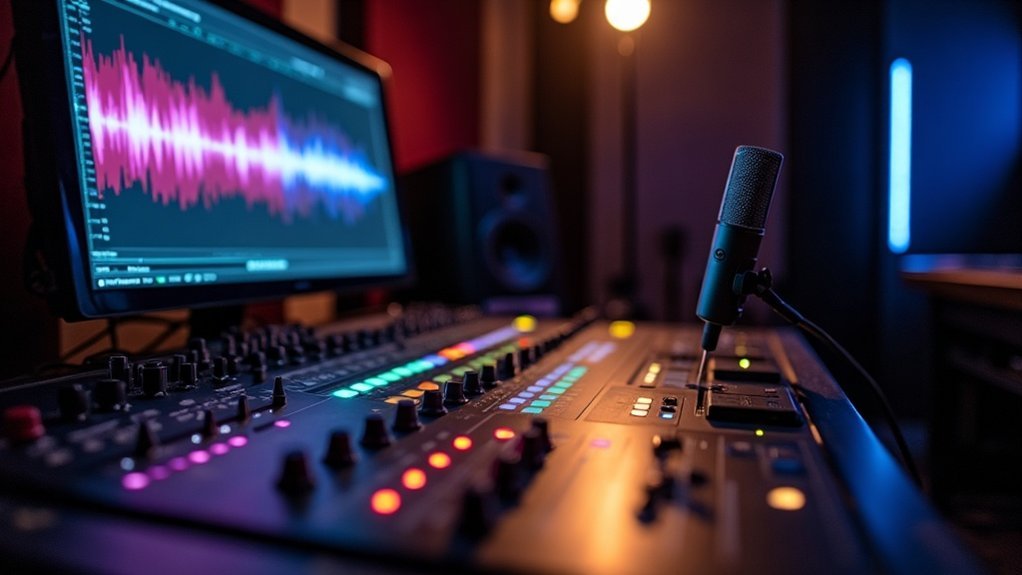
Understanding dBFS is essential for managing headroom levels, guaranteeing ideal peak levels, and mastering final outputs in your audio production workflow. Maintaining proper recording levels is crucial to prevent clipping and ensure optimal sound quality throughout the mixing and mastering processes. Additionally, having a solid grasp of headroom management can significantly enhance the overall clarity and impact of your audio projects.
Setting Headroom Levels
Setting appropriate headroom levels is essential for achieving ideal audio quality in production, as it directly impacts the dynamic range and clarity of the final mix.
When it comes to setting headroom levels, here are key considerations for maintaining clarity and ensuring the importance of headroom:
- Aim for a nominal operating level of around −18 dBFS.
- Keep loud sources between −12 to −6 dBFS during tracking to avoid overload.
- Maintain a −6 dBFS ceiling for mix buses to accommodate transient peaks.
- Regularly check meters throughout the process to prevent clipping and ensure balanced dynamics.
By focusing on setting headroom levels correctly, you establish a solid foundation for cleaner recordings and effective mixing, which is crucial for creators, gamers, and musicians alike. Understanding microphone gain can further enhance your control over the audio quality during recording.
Implementing these practices will help you maximize the quality of your audio, making sure every element is clear and dynamic, ultimately leading to a more polished final product.
Peak Level Management
Effective peak level management in audio production is essential, as it prevents clipping and preserves audio quality throughout the recording and mixing process. Mastering the art of peak level management ensures that you can maintain optimal sound integrity.
Employ peak monitoring techniques to keep transient spikes below 0 dBFS, ensuring your loudest peaks hover around −12 to −6 dBFS. Implementing transient control strategies is crucial for managing sudden levels, especially from instruments like drums and vocals.
By maintaining disciplined gain staging and closely monitoring mix bus levels, you can avoid cumulative overloads, which is a key aspect of effective peak level management. Always check for unexpected transients during full-program playback to safeguard against clipping and maintain the dynamic integrity of your final mix. Additionally, understanding audio clipping is vital to recognizing when levels exceed the digital limit, leading to distortion and compromised sound quality.
Mastering Final Outputs
Mastering final outputs in audio production is essential for ensuring your tracks meet industry standards while preserving sonic integrity. This process hinges on the precise application of dBFS.
To achieve optimal results in mastering final outputs, consider these key practices:
- Set limiter ceilings between −1.0 dBFS and −0.3 dBFS for effective peak reduction.
- Utilize true-peak metering to manage transient behavior and prevent distortion.
- Maintain loudness normalization (e.g., −23 LUFS for broadcast) to ensure your audio is competitive.
- Verify output calibration across devices for consistent audio fidelity, enhancing your final outputs.
By implementing these mastering techniques, you’ll enhance dynamic range and align your work with streaming standards, ultimately ensuring a polished final product that resonates with listeners.
Mastering final outputs isn’t just about loudness; it’s about clarity and impact that can elevate your audio projects, whether for podcasting, streaming, gaming, or recording.
Debunking Myths: dBFS vs. Perceived Loudness
While many audio engineers equate higher dBFS levels with louder sound, this assumption overlooks essential aspects of perceived loudness. In the context of debunking myths about dBFS vs. perceived loudness, it’s important to note that dBFS, which measures peak sample levels, doesn’t account for how our ears interpret sound. Factors such as frequency content, duration, and spectral density play a significant role in this interpretation.
| Myth | Explanation | Impact on Mixing |
|---|---|---|
| Higher dBFS = Louder | dBFS measures peaks, not perceived loudness. | Misleading dynamics |
| dBFS vs. LUFS | dBFS is peak level; LUFS reflects human loudness perception. | Essential for mastering |
| RMS = Perceived Loudness | RMS averages energy but doesn’t match loudness perception. | Inaccurate loudness cues |
dBFS Standards: What You Need to Know
Understanding dBFS standards is essential for accurate audio production and effective mixing techniques. dBFS standards, or decibels relative to full scale, provide a clear reference point for digital audio levels, with 0 dBFS representing the maximum amplitude.
Here are key points about dBFS standards:
- Calibration: Aligning levels to guarantee consistent headroom.
- EBU/AES Guidelines: Different standards for broadcast and post-production.
- True-Peak Limits: Essential for avoiding clipping in digital transmission.
- Operating Ranges: Keeping average levels around −18 to −20 dBFS for ideal mixing.
Understanding these aspects of dBFS standards ensures effective alignment and helps creators, gamers, and musicians avoid critical pitfalls in their audio projects.