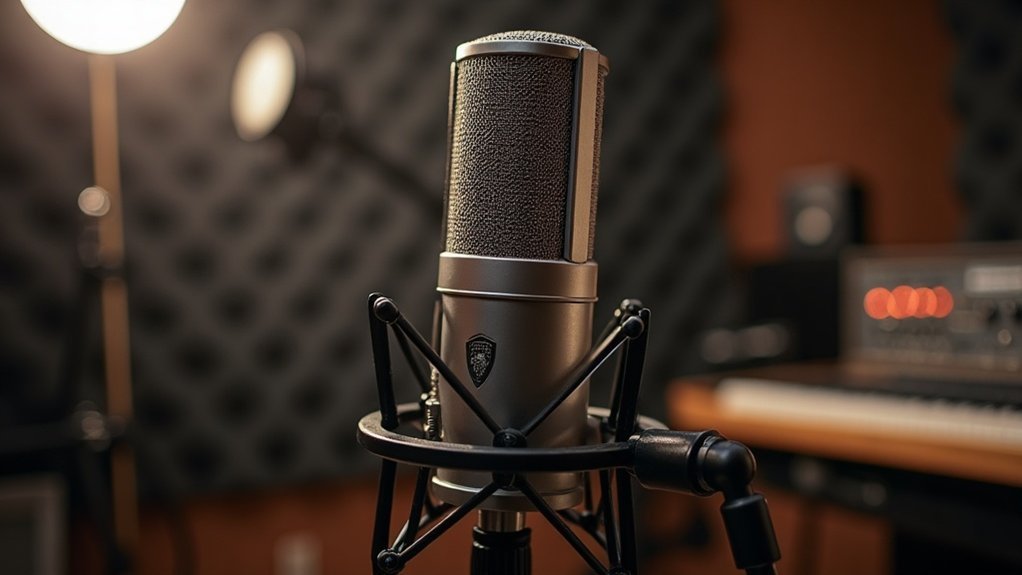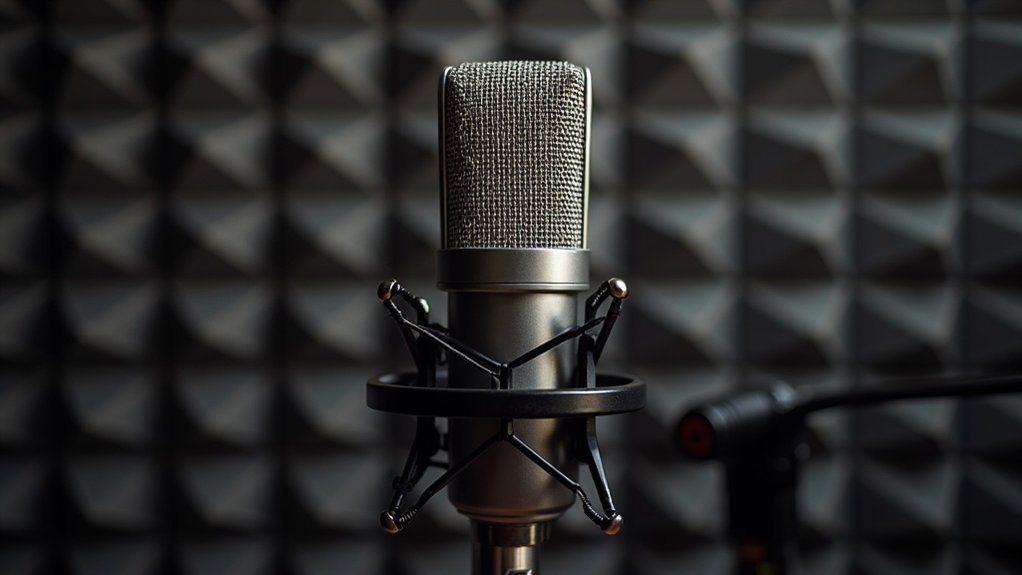
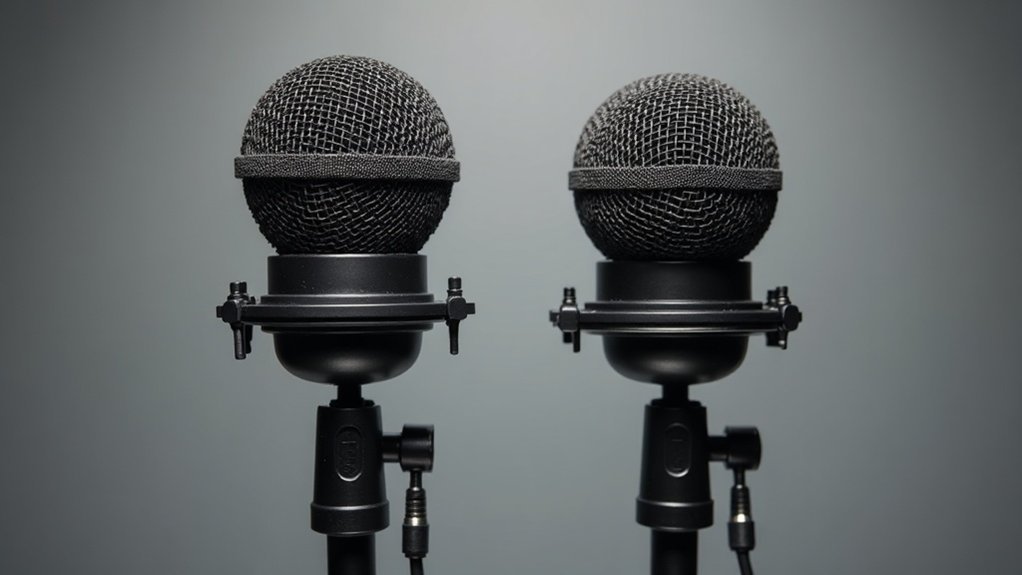
When you’re choosing between large and small diaphragm condenser microphones, you’re deciding between warmth and accuracy. Understanding the difference between a large and small diaphragm condenser is essential for making the right investment in your recording setup.
Large diaphragm condensers deliver lower self-noise and tonal coloration that flatters vocals, making them a favorite for podcasting and vocal recording. Small diaphragm condensers capture transients with precision and neutral frequency response ideal for instruments like drums, cymbals, and acoustic guitar. The differences between large and small diaphragm condensers extend beyond just pickup patterns—LDCs require less gain due to their sensitivity, while SDCs excel in dynamic range and articulation for capturing detailed instrumental nuance.
Your choice depends on whether you’re prioritizing the lush character vocals demand or the objective detail instrumental recordings need. For affordable recording setups, many creators and musicians find that understanding these large versus small diaphragm condenser distinctions helps them maximize their budget. Whether you’re streaming, gaming, or producing music, the difference between large diaphragm and small diaphragm condenser options directly impacts your final sound quality. This is precisely why professionals maintain both types in their toolkit—each excels in different applications and recording scenarios.
Key Takeaways
- Large diaphragm condensers produce warmer, more colored sound ideal for vocals, while small diaphragm condensers deliver neutral, accurate recordings.
- Small diaphragm condensers capture faster transients and detail, making them better for percussion and instrumental sources requiring precision.
- Large diaphragm condensers have lower self-noise and higher sensitivity, reducing gain requirements and minimizing amplification of background noise.
- Small diaphragm condensers offer greater dynamic range and objective accuracy, preserving transient details that larger models may smooth over.
- Large diaphragm condensers require more physical support due to bulkier design, while small diaphragm condensers fit tight spaces easily.
Diaphragm Size: The Core Difference Between LDC and SDC
The diaphragm materials and tension you select directly influence how each microphone responds to sound. Larger diaphragms move more easily, affecting sensitivity and output levels—a key factor when choosing between LDCs and SDCs for your podcasting, streaming, or recording setup. LDCs generally exhibit lower self-noise compared to SDCs, making them preferable for quiet recordings where background noise could compromise audio quality. Small diaphragm condensers typically excel with superior transient response, capturing detailed attacks and fast-moving sound sources with remarkable clarity.
Smaller diaphragms require greater acoustic energy to move, making them ideal for different applications depending on your needs as a creator or musician. Large diaphragm condensers are commonly used in vocal and speech recording applications where their sensitivity and proximity effect characteristics are particularly advantageous.
Understanding the core difference between LDC and SDC sizing principles helps you grasp why these microphones perform differently across sensitivity, transient response, and frequency characteristics.
When evaluating affordable microphones for your budget, recognizing how diaphragm size represents the core difference between LDC and SDC options ensures you select the right tool for vocals, instruments, or ambient recording.
This fundamental distinction directly impacts which condenser microphone will deliver the best results for your specific professional or creative application.
Capsule Design and Physical Form
| Aspect | Large-Diaphragm | Small-Diaphragm |
|---|---|---|
| Capsule Orientation | Typically side-address | Top or side-address |
| Body Layout | Broader housing, larger grille | Narrow cylindrical pencil format |
| Physical Implications | Prominent capsule assembly | Compact, tighter placement |
LDC capsules demand greater mechanical support around their diaphragm assembly, resulting in bulkier external profiles that affect positioning in cramped streaming or podcast setups. SDC construction minimizes mass and housing width, enabling the characteristic pencil-mic form factor that suits stereo arrays and close instrument positioning—a crucial consideration for musicians and content creators working with limited space. The grille assembly design in large diaphragm microphones plays a significant role in impacting overall acoustics and polar pattern consistency.
The physical form of microphone capsules directly impacts your workflow. Both designs employ charged diaphragm-backplate capacitor structures; construction differences in capsule design and physical form reflect practical mounting and aiming requirements rather than operating principles. The electrostatic transduction method used in condenser microphones requires careful capsule engineering to maintain sensitivity and frequency response across different physical formats. When evaluating affordable microphones for recording, gaming, or podcasting, recognizing how these capsule design variations influence real-world placement and accessibility ensures you select the right tool for your specific recording environment and creative needs.
Sound Character: Warmth vs. Neutrality
When you’re choosing between large and small diaphragm condensers, you’ll encounter a fundamental tonal difference: large diaphragm models typically emphasize low-mid warmth and smooth the upper frequencies, while small diaphragm condensers deliver flatter, more neutral frequency response with greater detail preservation.
You’ll find that large diaphragm microphones add presence and body to sources—particularly flattering for vocals—whereas small diaphragm designs capture your source more objectively without added coloration. The on-axis presence peak of large diaphragm condensers creates an intimate feeling that works especially well for spoken word and podcasting applications. Large diaphragm condensers are frequently selected for production environments where the added warmth enhances the overall sound character. Understanding how frequency response curves differ between these microphone types helps you predict how each will color your recordings.
This warmth-versus-neutrality distinction directly influences whether your recording sounds pleasantly enhanced or naturally accurate.
Warmth And Low-End Response
One of the most significant distinctions between large and small-diaphragm condensers lies in their approach to warmth and low-end response—specifically, how they reproduce these critical sonic characteristics. Large-diaphragm models deliver vocal warmth through frequency emphasis in the low and midrange, creating an intimate presence that feels fuller and more substantial. This tonal balance produces what engineers call lushness perception—a colored sound that enhances bass reproduction without sacrificing clarity. When evaluating warmth and low-end response, large-diaphragm condensers excel at creating presence through deliberate frequency shaping. This warmer character often appeals to human ears due to polar pattern irregularities that create pleasant harmonic coloration. The larger diaphragm mass in these designs contributes to lower transient response, which influences how warm frequencies are perceived and sustained. Large-diaphragm condensers are commonly used in professional studios specifically because their tonal characteristics enhance vocal and instrumental recordings with desirable sound coloration.
Small-diaphragm condensers, conversely, capture low-end richness more neutrally, prioritizing accuracy over sound coloration. Their approach to low-end response emphasizes transparency rather than character, making them ideal for sources requiring uncolored precision. The difference in how each type handles warmth and bottom-end frequencies directly impacts vocal recordings, instrument capture, and overall mix character.
| Characteristic | Large-Diaphragm | Small-Diaphragm |
|---|---|---|
| Vocal Warmth | Enhanced through midrange emphasis | Neutral, uncolored approach |
| Low-End Response | Fuller, lusher bass presence | Cleaner, more accurate reproduction |
| Tonal Balance | Deliberately colored and warm | Flat and unbiased |
| Sound Coloration | Pronounced character | Minimal coloration |
| Intimate Presence | Substantial and weighted | Clean and precise |
Your choice depends on whether you’re seeking characterful warmth or uncolored precision—a decision that fundamentally shapes how your recordings translate across playback systems and streaming platforms.
Neutral Frequency And Detail
Beyond the tonal coloration that large-diaphragm condensers introduce, the fundamental difference in how each microphone type captures sound boils down to frequency neutrality and detail retrieval**—two interconnected characteristics that define their sonic character and directly impact your neutral frequency and detail** performance.
Small-diaphragm condensers deliver extended high-frequency response and faster transient tracking, capturing micro-detail with objective accuracy across diverse recording environments. Their neutral frequency response makes them application versatile—you’ll achieve consistent results regardless of microphone positioning or recording techniques, essential for affordable microphones designed for podcasting, streaming, and recording without sonic compromise. SDCs typically feature fixed polar patterns that remain consistent across different frequencies, ensuring reliable directionality in varied acoustic spaces.
Large-diaphragm models, conversely, exhibit less neutral frequency and detail characteristics, with slower transient behavior that reduces microscopic detail retrieval. This tonal preference for coloration can work against accuracy-focused applications.
When your recording demands precision over character, small-diaphragm designs dominate through superior polar pattern comparison and unwavering frequency neutrality. For creators, gamers, and musicians seeking affordable options that prioritize neutral frequency and detail, understanding this distinction becomes critical to achieving professional results across every stage of your setup—from initial microphone selection through final recording execution.
Tone Color And Presence
While frequency response and transient behavior establish the technical foundation of microphone performance, tone color and presence—the perceived warmth, neutrality, and forward character of a microphone’s sonic signature—define how each capsule type shapes your source material.
Large-diaphragm condensers deliver vocal presence through warmth and coloration, making them ideal for lead vocals and intimate recordings. Small-diaphragm models offer neutral tonal characteristics, preserving authentic source material without added gloss. Your tone color choice depends on mixing preferences and genre suitability. Large-diaphragm condensers generally feature lower self-noise, which is particularly beneficial when recording quiet vocals and delicate instrumental performances.
When selecting microphones for podcasting, streaming, gaming, and recording, understanding how tone color affects presence becomes essential. Warm mics excel in sparse arrangements, adding richness to vocal recordings; neutral mics suit detailed orchestral work and transparent instrument capture. Dynamic microphones offer alternative characteristics that may suit certain applications where durability and feedback rejection are priorities.
Presence peaks in your microphone’s tone color profile can enhance clarity in competitive gaming setups or podcast dialogue, while smoother tonal presence characteristics work better for musical performances requiring authenticity.
Your microphone’s tone color and presence characteristics should align with your recording environment—whether you’re optimizing for a treated studio, untreated bedroom, or live streaming space.
Understanding these microphone applications across varied setups guarantees your tone color and presence characteristics match your artistic intent while maximizing the performance of affordable options in every price range.
Transient Response and Detail Capture
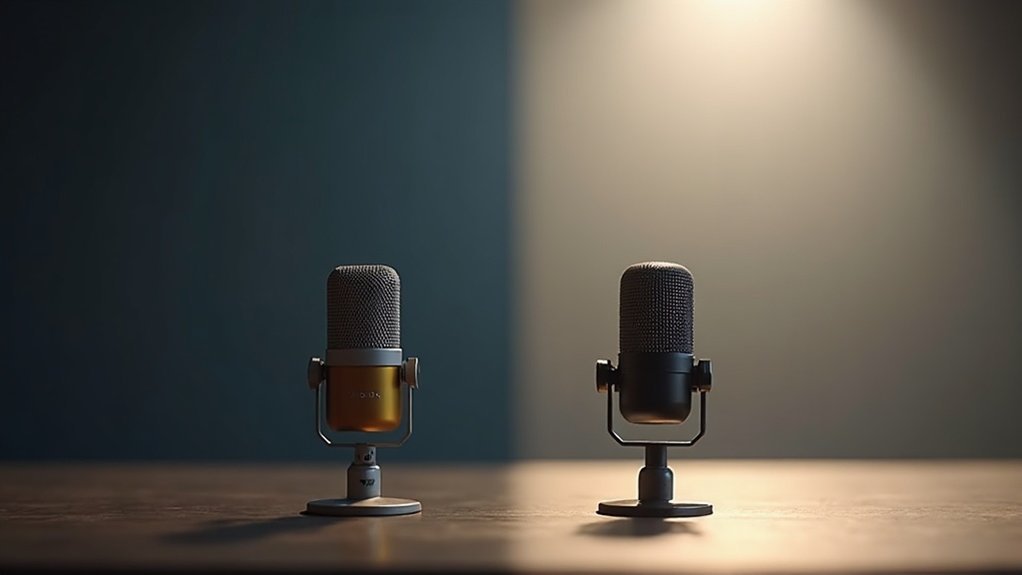
Because smaller diaphragms carry less mass, they’ll respond more quickly to sudden sound changes than their larger counterparts—a critical advantage for capturing transient response and detail capture**** that separates quality recordings from mediocre ones. This speed advantage delivers meaningful benefits:
- Transient accuracy — Small diaphragm condensers follow rapid waveform changes closely, preserving the leading edge of notes and articulation in plucked strings and percussion. This transient response ensures every nuanced attack reaches your recording uncompromised.
- Detail preservation — Extended high-frequency response and sharper attack capture create the impression of greater clarity and natural sound reproduction. The superior detail capture from small diaphragms reveals subtle frequencies that larger condensers miss, making them invaluable for podcasters, streamers, and musicians recording at any budget level.
- Percussive precision — Crisp “click” and “snap” components remain intact across stereo overhead recordings, supporting subtle performance nuance capture. This transient and detail capture capability is especially crucial for gaming streamers and content creators who need every articulation defined.
Large diaphragm condensers soften attacks slightly, trading transient response and detail capture precision for a smoother, warmer character that some sources find more flattering.
For creators prioritizing accuracy over aesthetic coloration, smaller diaphragms deliver superior performance at affordable price points across the market.
Sensitivity, Noise, and Dynamic Range
When you’re comparing large-diaphragm condensers (LDCs) to their smaller counterparts, you’ll notice that LDCs typically deliver higher output voltage—around 22 mV/Pa versus 10 mV/Pa for small-diaphragm condensers (SDCs)—because their larger diaphragms move more freely and convert sound more efficiently.
This sensitivity advantage means you’ll need less preamp gain to reach usable recording levels, which also reduces the noise contribution from your preamp itself. Understanding microphone sensitivity helps you make informed decisions about which microphone type best suits your recording needs.
However, this higher sensitivity doesn’t necessarily translate to superior dynamic range; SDCs often outperform LDCs in total usable range because they can handle louder sound-pressure levels before distortion while maintaining comparable noise floors.
Higher Sensitivity in LDCs
Large-diaphragm condensers (LDCs) typically produce roughly twice the output voltage of small-diaphragm condensers (SDCs) at the same sound pressure level, a difference rooted in diaphragm physics and capsule design. This higher sensitivity in LDCs represents one of their most compelling advantages for creators, musicians, and recording professionals seeking affordable microphones without sacrificing performance. Unlike dynamic microphone designs, condensers rely on capacitive principles where larger diaphragms increase the overall capacitance and improve voltage output efficiency.
You’ll find higher sensitivity in LDCs particularly valuable for:
- Low level capture—larger diaphragm compliance moves easier, generating stronger output from subtle sound pressure variations, making budget-friendly LDCs competitive with premium equipment.
- Preamp compatibility—reduced gain demands minimize noise floor amplification in your signal chain, crucial for home studios and streaming setups.
- Nuanced sounds—enhanced ambient details and dynamic response reveal recording environments you’d otherwise miss, essential for podcasting and gaming content.
This sensitivity boost makes capturing soft vocals and delicate instruments straightforward, though you’ll need treated spaces to control unwanted room noise effectively.
The higher sensitivity in LDCs becomes especially practical when you’re building a budget recording setup, as it means your affordable microphone performs closer to studio-grade equipment.
For gamers recording voiceovers, musicians tracking quiet passages, and professionals handling low-level sources, understanding how higher sensitivity in LDCs operates helps you maximize your gear investment and achieve broadcast-quality results without expensive preamps or signal processors.
Self-Noise and Dynamic Range
When evaluating microphones for your setup, prioritize models with low self-noise ratings—this measurement reveals the electronic hiss floor and determines how cleanly you can capture quiet vocals, ambient recordings, and subtle instrument details without unwanted background noise coloring your final mix.
When to Choose LDC: Vocals, Warmth, and Presence
Because vocal recordings demand tonal character and presence in studio settings, large-diaphragm condensers have become the standard choice for lead vocal tracking. If you’re deciding when to choose LDC microphones, you’ll find they excel when your vocal styles and genre considerations require a polished, forward sound rather than neutral capture.
They deliver warmth and body that enhance recording environments where tonal preferences lean toward lush presentation. While dynamic microphones offer certain advantages for specific vocal applications, condensers remain the preferred choice for most studio vocal work.
When to choose LDC depends on your priorities:
- Presence and size – Makes vocals sit prominently in mixes, especially when choosing LDC for vocals that need to command attention.
- Warm coloration – Adds low-end weight and fullness that characterizes why professionals choose LDC condensers for vocal work.
- Musical character – Suits produced vocal aesthetics across genres; understanding when to choose LDC means recognizing your need for this tonal sweetening.
For creators, musicians, and streaming professionals tracking vocals on a budget, learning when to choose LDC can mean the difference between a thin, generic vocal sound and one with character and presence.
Their less neutral response becomes an asset, not a liability, when you’re prioritizing finished studio sound over measurement accuracy.
When considering whether to choose LDC microphones for your setup, remember that this coloration directly serves the polished vocal recordings expected in modern production.
When to Choose SDC: Instruments, Detail, and Accuracy
Small-diaphragm condensers serve a fundamentally different purpose than their larger counterparts: capturing instrumental sources with precision rather than personality. Understanding when to choose SDC instruments is essential for achieving professional results. You’ll find SDCs excel at transient capture, preserving pick attacks and bow detail with accuracy LDCs can’t match. Their flatter frequency response supports acoustic precision, while consistent polar patterns enable reliable ensemble imaging. For detail retrieval in upper harmonics, SDCs outperform alternatives.
| Source | SDC Advantage |
|---|---|
| Percussion | Fast attack clarity |
| Acoustic Guitar | String articulation |
| Piano | Note definition |
| Strings | Bow texture |
When to choose SDC microphones depends on your recording priorities. Select SDCs for instruments when your sources demand neutrality and articulation preservation over warmth. This approach to choosing small-diaphragm condensers ensures you capture every nuance of instrumental detail—from the snap of a snare to the shimmer of cymbal overtones. Whether you’re recording in a home studio or professional setting, knowing when to choose SDC detail and accuracy separates amateur recordings from polished productions. SDC instrument recording demands precision, and these microphones deliver exactly that.