Your voice sounds different on a microphone because you’re hearing two distinct acoustic signals simultaneously—bone conduction traveling directly through your skull to your inner ear, and air conduction that only your microphone captures. This fundamental difference in how your voice sounds different on a microphone explains much of the surprise you experience upon first recording.
Bone conduction naturally boosts lower frequencies below 2 kHz, making your internal voice sound deeper and warmer. Microphones exclude this pathway entirely, capturing solely airborne sound, which removes essential low-frequency enhancement. This is why your voice sounds different when recorded—the microphone simply cannot replicate the natural bass enhancement your body provides during normal speech.
Additionally, your microphone’s design, proximity effect, and room acoustics further shape the final recording. The specific microphone model you choose plays a crucial role in how different your voice sounds when captured. Budget-friendly microphones often emphasize these discrepancies more prominently than professional-grade equipment, though understanding why your voice sounds different on a microphone helps you make informed decisions about which affordable microphone best suits your podcasting, streaming, gaming, or recording needs.
Recognizing that your voice sounds different on a microphone is entirely normal—it’s not a flaw in your equipment or your voice itself. Rather, it’s an acoustic reality that creators, musicians, and professionals overcome through proper microphone selection, positioning, and room treatment to achieve recordings that sound closer to how you actually perceive your own voice.
Key Takeaways
- Bone conduction through your skull naturally enhances low frequencies your microphone cannot capture from airborne sound alone.
- Microphone design, polar patterns, and proximity effects significantly influence how your voice’s frequencies are recorded and translated.
- Your brain’s internal voice template combines bone and air conduction, creating a perception mismatch with microphone-only airborne capture.
- Recording devices and operating system processing alter frequency response and gain before you hear the final playback.
- Initial discomfort with recorded voice reflects neurocognitive processing of expectation violations rather than actual equipment inadequacy.
Why Your Voice Sounds Deeper in Your Head
When you hear your own voice internally, it’s filtered through acoustic pathways that fundamentally alter its character, which explains why your voice sounds deeper in your head than in reality. Your nasal, oral, and pharyngeal cavities shape formants, emphasizing darker, fuller qualities in your vocal timbre. This internal filtering boosts low and mid frequencies while attenuating high-frequency components, creating an acoustic illusion of depth that’s key to understanding why your voice sounds deeper in your head when you speak.
Your auditory cortex amplifies this effect through brain processing, assigning greater weight to lower-frequency signals from your internal path. Combined, these mechanisms—resonance shaping and frequency emphasis—produce a voice perception substantially deeper than what external recordings capture. This is precisely why your voice sounds deeper in your head compared to podcast recordings, streaming audio, or gaming communications where listeners hear your actual vocal output. Understanding frequency response characteristics helps explain how microphones capture different frequency ranges than your internal perception.
For content creators, musicians, and streamers investing in microphones for podcasting or recording, understanding why your voice sounds deeper in your head becomes crucial. The discrepancy between your internal voice perception and external recordings may also create voice confrontation, a psychological discomfort that many experience when first hearing their recorded voice.
What you perceive as your natural voice timbre during recording sessions differs significantly from what your audience hears through affordable microphones and speakers. Establishing your habitual self-voice reference as richer than objective reality means you’ll need quality gear and proper audio setup tips to capture the actual vocal character your listeners experience, bridging the gap between your internal voice perception and external reality.
How Bone Conduction Creates the Difference
When you speak, you’re experiencing your voice through two distinct pathways—bone conduction traveling directly through your skull to your inner ear, and air conduction reaching your ear through the atmosphere.
This dual transmission creates the depth and warmth you perceive internally. Your microphone captures primarily the airborne component, missing the low-frequency emphasis that bone conduction provides. Unlike traditional hearing that relies on the eardrum vibrating to stimulate the cochlea, bone conduction sends sound directly to the cochlea, bypassing this intermediate step entirely. Poor signal to noise ratio in your recording environment can further degrade the fidelity of what your microphone captures.
This explains why your recorded voice sounds thinner and higher-pitched than what you hear in your head. This frequency mismatch is most pronounced between 700 Hz and 1200 Hz, where bone conduction dominates your self-perception and enriches your sense of vocal power.
Internal Resonance and Depth
Because your ear combines both air-conducted and bone-conducted sound pathways, you perceive your voice with a fullness that standard microphones can’t replicate. Your vocal resonance travels through skull and soft tissue, creating internal acoustics that enhance depth and richness. These structure-borne vibrations emphasize low frequencies while traveling directly to your cochlea, bypassing external ear filtering.
Meanwhile, microphones capture only airborne sound, missing this resonant component entirely. This divergence in sound perception explains why your frequency balance feels warm and expansive internally, yet recordings reveal timbral differences—a leaner, thinner rendition lacking the internal acoustic reinforcement your auditory processing naturally expects. Research using bone-conduction microphones has demonstrated that specialized shielding can significantly improve speech clarity in challenging acoustic environments by reducing noise interference. The self noise inherent in most microphones can further mask these subtle acoustic details that your internal perception naturally captures.
Understanding this internal resonance and depth is crucial when selecting affordable microphones for recording, streaming, or podcasting. Even budget-friendly microphones can capture quality audio once you recognize how internal resonance shapes your perception of your own voice.
When evaluating microphones for gaming, podcasting, or professional recording, accounting for this natural internal depth helps you make informed purchasing decisions. The gap between what you hear internally versus what your microphone captures represents the core challenge in achieving authentic recordings.
As you compare microphones and review specifications, remember that internal resonance and the depth it creates remain constant factors in your auditory experience—only the microphone’s ability to bridge that gap varies.
The Bone-Conduction Advantage
The dual-pathway nature of self-voice perception—bone conduction and air conduction operating simultaneously—fundamentally explains why your voice sounds richer internally than in recordings. Your skull acts as an acoustic filter, emphasizing frequencies between 300–1200 Hz while attenuating higher frequencies above 2–3 kHz. This spectral reshaping creates the fuller, darker tone you recognize as authentically yours. Bone conduction bypasses the ear canal, sending vibrations directly through your skull bones to the cochlea.
Understanding the bone-conduction advantage is crucial when selecting microphones for recording, streaming, or podcasting. Simultaneously, vibration cues from bone conduction deliver vibrotactile and somatosensory signals that standard microphones can’t capture. This multisensory integration—auditory, tactile, proprioceptive—establishes your voice identity and deepens self-awareness in ways affordable microphones struggle to replicate during playback. Bone conduction microphones utilizing piezoelectric sensors can convert these jawbone vibrations into electrical signals, capturing your voice more authentically than traditional air-conduction microphones. Condenser microphones, by contrast, rely on capacitive sensing to detect air-pressure changes rather than direct vibrations, making them fundamentally different in their transduction mechanism.
The bone-conduction advantage explains a frustrating reality for creators and musicians: recordings capture only air-conducted sound, eliminating bone conduction’s filtering and sensory richness entirely, producing acoustic mismatch. When you hear your recorded voice in podcasting or streaming setups, you’re missing the natural enhancement your skull provides in real-time communication.
Recognizing this bone-conduction advantage helps musicians, gamers, and professionals set realistic expectations for their microphone reviews and comparisons. While no microphone can reproduce bone conduction’s multisensory component, understanding this acoustic principle informs better buying decisions and setup optimization across recording, streaming, and gaming applications.
Missing Low Frequencies
Your skull’s vibration-transmission system emphasizes lower frequencies in ways standard microphones can’t replicate, which is why recorded speech sounds thinner and higher-pitched than you perceive it internally. This missing low frequencies phenomenon is one of the most common shocks when creators and streamers first hear their recorded voice through affordable microphones.
Bone conduction transmits frequencies below 2 kHz more effectively than air conduction alone, creating the low frequency emphasis that defines your voice perception during speaking. A microphone captures only airborne sound, missing the skull-transmitted pathway entirely. This absence of missing low frequencies** in your recording setup means you’re losing the fundamental acoustic data** your brain normally processes together.
When gamers, podcasters, and musicians first encounter this acoustic gap, they often assume their microphone is broken or inadequate. The reality is that all microphones—whether budget-friendly or professional-grade—capture airborne sound only. This missing low frequencies issue strips away the resonance and warmth you’ve grown accustomed to hearing in your own voice.
The recorded playback isn’t inaccurate—it’s simply incomplete. Understanding missing low frequencies helps creators adjust their expectations and mix their audio appropriately. Many affordable microphones actually perform admirably once you account for this natural limitation and compensate during post-production.
Rather than treating missing low frequencies as a flaw, experienced streamers and podcasters view it as a normal characteristic to work with, not against.
Why Recordings Capture a Different Sound
How exactly does a microphone fail to reproduce what you hear internally? Understanding why recordings capture a different sound requires examining the gap between internal and external audio perception. Your recording captures only air-conducted sound, missing the bone-conduction vibrations that enrich your self-perception.
Standard recording techniques and audio fidelity limitations create this fundamental difference in how recordings capture sound:
- Microphones capture single-point acoustic data, excluding internal resonance pathways.
- Bone-conducted frequencies reinforce lower registers you naturally perceive.
- Vocal tract resonances—throat, sinuses, chest cavity—transmit internally but bypass external capture.
- Playback devices reproduce the externally-heard version, stripping complex internal harmonics.
This explains why your recording sounds thinner, brighter, and higher-pitched than your internal reference. You’re hearing what others actually hear—your authentic external voice. The diaphragm vibration in microphones responds to sound pressure waves traveling through air, but this mechanical process cannot capture the internal vibrations from bone conduction that naturally enrich your self-perception. Your vocal cords vibrate through your skull, creating low-frequency enhancement that recordings cannot replicate. The diaphragm’s mechanical response to acoustic pressure is fundamentally limited to capturing only the external sound waves that reach the microphone.
For content creators, streamers, and podcasters investing in affordable microphones, recognizing why recordings capture a different sound is crucial for managing expectations during setup and testing phases.
The technical reasons recordings capture sound differently directly impact how you should evaluate microphone quality during reviews and comparisons.
When testing budget-friendly options for gaming or professional use, remember that what your microphone captures represents your actual broadcast voice—not the enhanced internal version your ear naturally produces. This distinction matters significantly when comparing microphone performance and selecting equipment for your specific recording needs.
Microphone Design and Room Acoustics

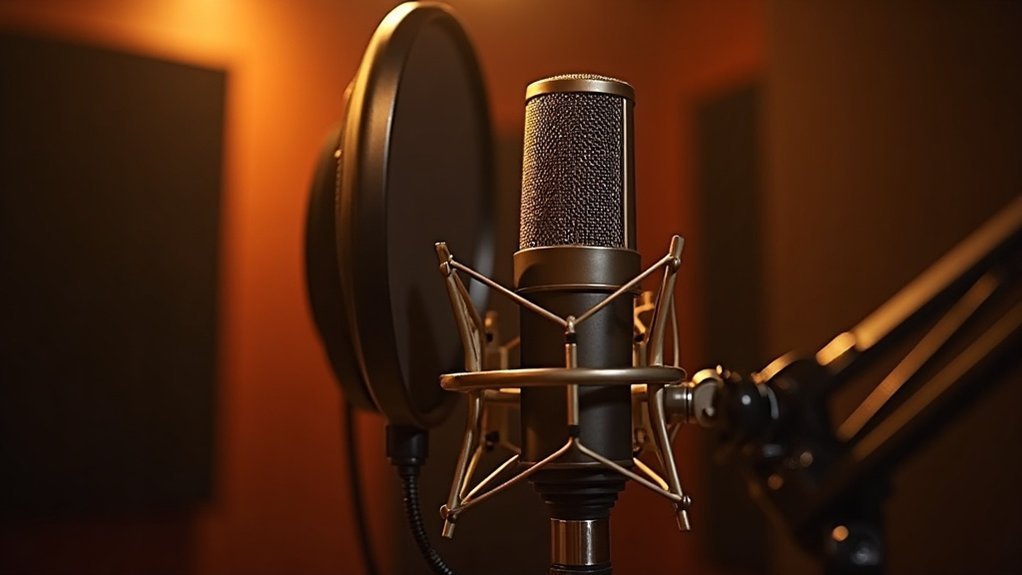
Microphone design and room acoustics fundamentally reshape how your voice translates to recording, making it essential to understand the relationship between capsule type, frequency response, and mic placement for capturing your authentic vocal character.
When optimizing your microphone design and room acoustics setup, condenser microphones deliver superior sensitivity and extended frequency response compared to dynamic types, revealing vocal nuance that matters for professional-quality recordings.
Large-diaphragm condenser models emphasize warmth, while small-diaphragm designs offer the neutrality that many creators and musicians prefer. Your microphone’s polar patterns and off-axis behavior—core elements of effective microphone design—determine how room acoustics blend with direct voice capture. Omnidirectional microphone patterns capture sound from all directions, which can significantly impact how ambient room noise integrates with your vocal recording.
The interaction between your microphone design choices and room acoustics can either enhance or degrade your final recording.
Proximity effect boosts bass when you position mics too close, a critical consideration in microphone design and room acoustics planning. Achieving flat frequency response across your vocal range—variation under 2 dB—minimizes unwanted sound coloration, ensuring your recording quality reflects your true voice while managing dynamic range effectively. Cardioid condenser microphones demonstrate the smallest effect on vocal perturbation measurements, making them an optimal choice for capturing authentic vocal characteristics. Different microphone types alter the frequency spectrum of voice signals, which can affect how accurately your vocal characteristics are represented in recordings.
Strategic microphone design paired with thoughtful room acoustics treatment creates the foundation for authentic vocal capture across podcasting, streaming, gaming, and professional recording applications.
Why Your Brain Rejects the Recording
Your brain constructs an internal template of your voice built from years of bone and air conduction combined, creating an expectation that your recorded voice—delivered solely through air conduction—fundamentally violates.
This mismatch between what you’ve learned to expect and what you actually hear triggers what researchers call the “familiarity illusion,” where your brain treats the thinner, higher-pitched recording as a foreign acoustic stimulus rather than an accurate representation of yourself.
Because you’ve never habituated to this air-conduction-only version, your auditory system flags it as novel and discrepant, generating the immediate rejection and discomfort you experience.
The Familiarity Illusion
Recordings deviate from this familiar blueprint, and recognizing this cognitive pattern helps you evaluate microphone quality objectively:
- Your auditory system prioritizes stable features, filtering natural variability.
- Microphones capture acoustic properties absent from bone conduction.
- This mismatch triggers heightened sensitivity to deviations.
- Your brain treats the most fluently processed version as authentic.
The familiarity illusion effect explains why even excellent microphones for streaming or podcasting can initially sound strange. The recording’s unfamiliar properties reduce processing fluency, making accuracy feel alien. Additionally, microphones may pick up background noise that your internal perception naturally filters out, further contributing to the sense of acoustic strangeness.
This is particularly important when testing affordable microphones or comparing gear—what feels “wrong” acoustically may actually be the most honest representation of your voice.
You’re experiencing not acoustic reality but the brain’s preference for familiar neural pathways. For gamers, musicians, and podcasters selecting the right microphone, overcoming the familiarity illusion means giving your new equipment proper audition time.
Your ears will adjust to the accurate sound, and within days, yesterday’s “alien” recording becomes your new normal. This cognitive shift is essential for making confident microphone purchasing decisions and getting the most out of your streaming or recording setup.
Expectation Mismatch Effect
Your brain’s been constructing a stored expectation of your voice through years of bone-conducted and air-conducted feedback, and the moment the recording deviates from that template, a prediction error occurs. This mismatch triggers the expectation mismatch effect—a conflict between what you expect and what you perceive.
Your anterior superior temporal gyrus activates, processing the violation of self-voice expectations. The sensory feedback you’re receiving contradicts your learned internal model, creating certainty loss about voice identity and producing that uncomfortable, “that’s-not-me” reaction.
Understanding this expectation mismatch effect is crucial when you’re evaluating microphone recordings during the buying process. What sounds “wrong” in your initial playback isn’t necessarily a flaw in the equipment—it’s your brain experiencing this predictive error as the voice expectation mismatch becomes apparent. Beyond psychological factors, microphone placement and distance also significantly impact how your voice is captured and perceived during recording.
Podcasters, streamers, and musicians often struggle with this phenomenon when testing affordable microphones, mistaking the expectation mismatch effect for poor mic quality. After several recording sessions with your new setup, your brain recalibrates its internal model, and the expectation mismatch effect diminishes.
The key is recognizing that this initial discomfort reflects neurocognitive processing rather than microphone performance, allowing you to make equipment decisions based on actual audio quality rather than the disorienting sensation of the expectation mismatch effect.
Device, App, and Processing Variations
Even when you’re using the same microphone, the device capturing your voice—whether it’s a phone, laptop, headset, USB interface, or studio setup—fundamentally shapes how you sound through differences in frequency response, sensitivity, and noise characteristics.
Understanding device, app, and processing variations is essential for anyone serious about voice quality, whether you’re podcasting, streaming, gaming, or recording music.
Your recording settings and app processing layers add further transformation. Device and app variations can dramatically alter your final output, sometimes more than your microphone choice itself.
Consider these factors:
- Aggressive compression reduces dynamic range, flattening warmth and presence
- Operating-system enhancements alter input gain and tonal balance automatically
- Microphone types emphasize different vocal frequencies based on capsule design
- Signal chain components introduce preamp coloration before editing begins
How device, app, and processing variations compound depends on your complete hardware and software ecosystem.
A budget-friendly microphone paired with poor device settings will underperform compared to the same mic optimized through proper app configuration and processing choices.
The degree to which compression and EQ affect your voice depends significantly on your device’s available headroom and how much dynamic range your microphone can capture before clipping occurs.
These device impacts compound, making consistent voice capture dependent on understanding your complete hardware and software configuration—particularly crucial when comparing affordable microphones across different setups.
Hearing Your Voice as Others Do
When you’re hearing your voice as others do, you’ll notice an immediate and jarring difference from what you’re accustomed to. This gap exists because you perceive your own voice fundamentally differently than external listeners—a distinction crucial for anyone involved in podcasting, streaming, or recording music.
You’re hearing bone-conducted vibrations that boost low frequencies, creating richness that external listeners don’t receive. Your auditory perception combines internal resonance with air conduction, while microphones capture only air-conducted sound. This mismatch—missing the low-frequency depth you expect—makes recordings sound thinner and higher-pitched than your internal perception.
Others hear your actual vocal identity through air conduction alone, shaped by your vocal tract and room acoustics. When you finally experience hearing your voice as others do through a quality microphone recording, the shock stems from this neurophysiological disconnect. Understanding microphone sensitivity helps explain why different microphones capture your voice with varying levels of detail and presence.
For content creators and musicians, understanding this principle is essential when selecting affordable microphones for your setup. This explains why professional streamers and podcasters invest time in microphone comparisons and acoustic treatment—they’re learning to bridge the gap between internal perception and how their audience actually hears your voice.
Recognizing this difference helps you interpret recorded playback accurately and make informed decisions during your microphone buying journey. Rather than assuming your voice sounds “wrong” in recordings, you’re simply experiencing the reality of how others perceive your vocal performance through air conduction alone.