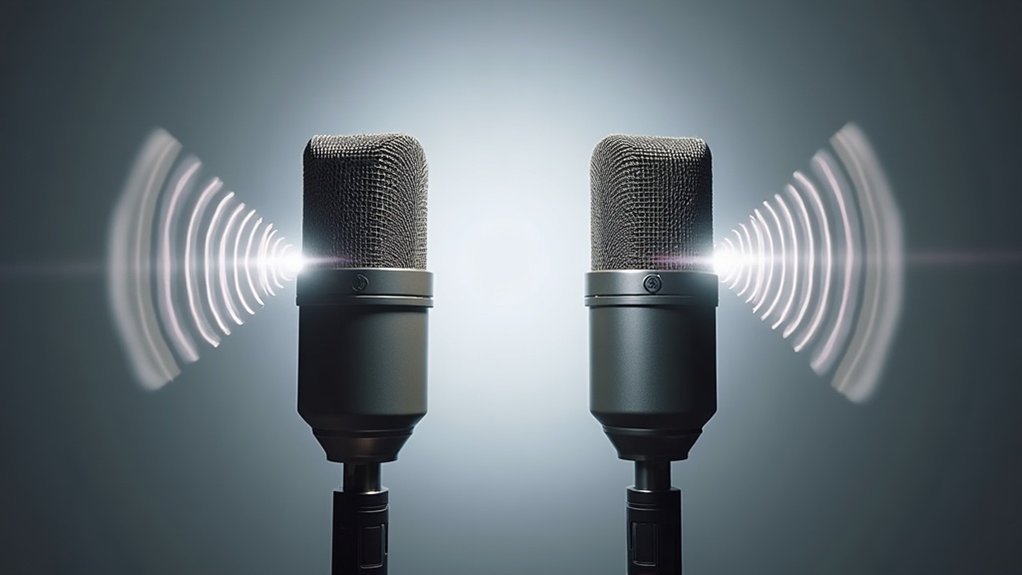
Understanding the difference between supercardioid and hypercardioid microphones is essential for selecting the right tool for your recording setup. Supercardioid and hypercardioid microphones differ in pickup angles and rear sensitivity, with each pattern offering distinct advantages for different applications.
Hypercardioid’s tighter 105° pickup isolates sound better, making it ideal for noisy environments, but requires precise placement due to off-axis coloration. In contrast, supercardioid’s 115° angle forgives positioning errors and rejects rear sound at –12 dB versus hypercardioid’s –6 dB, making supercardioid the better choice for live stages where mic movement is inevitable.
The difference between supercardioid and hypercardioid extends to proximity effects as well. You’ll encounter hypercardioid’s aggressive proximity effect—a 6–10 dB bass boost at close range—which can either enhance or muddy your vocals depending on your distance and technique.
For podcasters and streamers, recognizing these differences between supercardioid and hypercardioid patterns helps you avoid costly mistakes. Hypercardioid excels when you need maximum isolation in multi-person setups or loud environments, while supercardioid provides more forgiving performance for solo creators who may shift position during long recording sessions.
Understanding which pattern suits your specific acoustic environment and workflow reveals the best choice for your budget and needs.
Key Takeaways
- Pickup Angles: Hypercardioid has a 105° pickup angle versus supercardioid’s 115°, making hypercardioid more directional and isolated.
- Rear Lobe Sensitivity: Hypercardioid captures rear sound at –6 dB while supercardioid captures at –12 dB, affecting side rejection differently.
- Placement Tolerance: Supercardioid is more forgiving with placement errors; hypercardioid requires precise positioning to avoid off-axis coloration.
- Proximity Effect: Hypercardioid produces a 6–10 dB low-end rise at close range, creating tonal imbalance compared to supercardioid.
- Best Uses: Hypercardioid excels in noisy environments like podcasting; supercardioid suits live stages needing balanced directionality and feedback control.
Tighter Front Pickup: Which Wins?
Hypercardioid operates at approximately 105° pickup angles compared to supercardioid‘s 115°—a meaningful difference in controlled environments. This narrower acceptance area delivers superior isolation benefits, particularly when you’re close-miking sources in noisy settings. The pronounced proximity effect in hypercardioid microphones boosts low frequencies when positioned close to sound sources, enhancing warmth and depth in your recordings.
For podcasters and streamers working in untreated spaces, tighter front pickup characteristics mean you’ll capture your intended sound with minimal ambient bleed. Understanding how polar patterns shape your microphone’s directional response helps you choose the right tool for your specific recording environment.
However, this tighter front pickup design demands precise placement; small angle shifts noticeably affect tone. The hypercardioid’s concentrated front lobe requires careful positioning to avoid proximity effect and off-axis coloration—critical considerations for gaming setups and professional recording. Hypercardioid mics are more sensitive to rear sound compared to supercardioid options, which can introduce unwanted pickup from behind the microphone.
Supercardioid’s slightly wider front lobe—while still delivering focused tighter front pickup benefits—offers strong directionality while remaining more forgiving of placement errors. This makes it ideal for creators who move during streaming sessions or musicians who can’t maintain perfect mic technique throughout lengthy recordings.
For budget-conscious producers evaluating microphone options, tighter front pickup performance directly impacts recording quality. Choose hypercardioid when isolation matters most and your setup allows for fixed positioning; select supercardioid when you want directional control without extreme placement sensitivity.
Both patterns significantly outperform cardioid options for directional recording tasks.
Why Hypercardioid’s Rear Lobe Beats Supercardioid
While hypercardioid‘s tighter front pickup offers superior isolation, its rear-lobe characteristics reveal a different story about directional sensitivity. When comparing these patterns, hypercardioid’s rear lobe beats supercardioid in a crucial way: it sits around –6 dB at 180°, substantially larger than supercardioid’s –12 dB. This rear lobe advantage means hypercardioid captures more direct rear sound—a defining tradeoff, not a defect.
For creators and streamers, understanding why hypercardioid’s rear lobe beats supercardioid becomes essential when selecting microphones for live reinforcement. The nulls shift forward to 109°–110°, reducing side pickup but strengthening rear-facing sensitivity. You’re fundamentally trading side rejection for increased rear directional sensitivity. This distinction matters whether you’re podcasting in untreated spaces or gaming with background noise concerns. Hypercardioid microphones require precise placement to achieve optimal performance and maximize their directional advantages.
The reasons hypercardioid’s rear lobe outperforms supercardioid’s rejection come down to polar pattern physics. Musicians and professionals benefit from this understanding when choosing between patterns for recording vocals, instruments, or spoken word. Both patterns experience proximity effect, which increases bass response when positioned close to sound sources. Understanding cardioid and omnidirectional patterns provides foundational knowledge for evaluating how directional microphones function across different applications.
Hypercardioid’s rear lobe characteristics excel when you need maximum overall directionality despite the tradeoff of increased rear pickup.
For affordable microphone buyers evaluating options across every stage of the journey, this knowledge helps you choose the right pattern: hypercardioid for maximum overall directionality in controlled environments, supercardioid for safer rear rejection during live reinforcement where stray sounds might otherwise leak through the rear.
Hypercardioid’s Proximity Effect: What’s the Real Cost?
Understanding Hypercardioid’s Proximity Effect: What’s the Real Cost?
How much bass buildup can you actually expect when you move a hypercardioid microphone closer to your source? You’re looking at 6–10 dB of low-end rise within close range, creating tonal imbalance rather than simple bass enhancement.
This hypercardioid proximity effect stems from the microphone’s gradient design—its pressure-difference sensing intensifies as distance decreases. You’ll notice audio coloration around two inches, with very high intensity below 50 cm. The diaphragm design of gradient microphones, where sound impacts from both front and back, creates these pressure differences that intensify the proximity effect at close distances. Multi-pattern microphones offer flexibility by allowing you to switch from hypercardioid to omnidirectional patterns to reduce excessive bass buildup when needed.
For creators and streamers working with budget-friendly setups, understanding what’s the real cost of hypercardioid’s proximity effect is essential to achieving professional results. The real cost isn’t warmth; it’s muddiness and masked sound clarity. A microphone’s polar pattern determines how it responds to sound from different directions and directly influences how proximity effects manifest in your recordings.
When you recognize how hypercardioid’s proximity effect impacts your recordings, you can make informed decisions about microphone placement and technique.
Musicians, podcasters, and gamers often discover that hypercardioid’s proximity effect—while offering superior directional rejection—demands careful management.
Tight distance control and precise microphone placement become non-negotiable. You’re trading directional rejection for demanding proximity management, making hypercardioid a focused tool requiring discipline and intentional technique refinement during your recording sessions.
Live Stages vs. Studios: Where Each Belongs
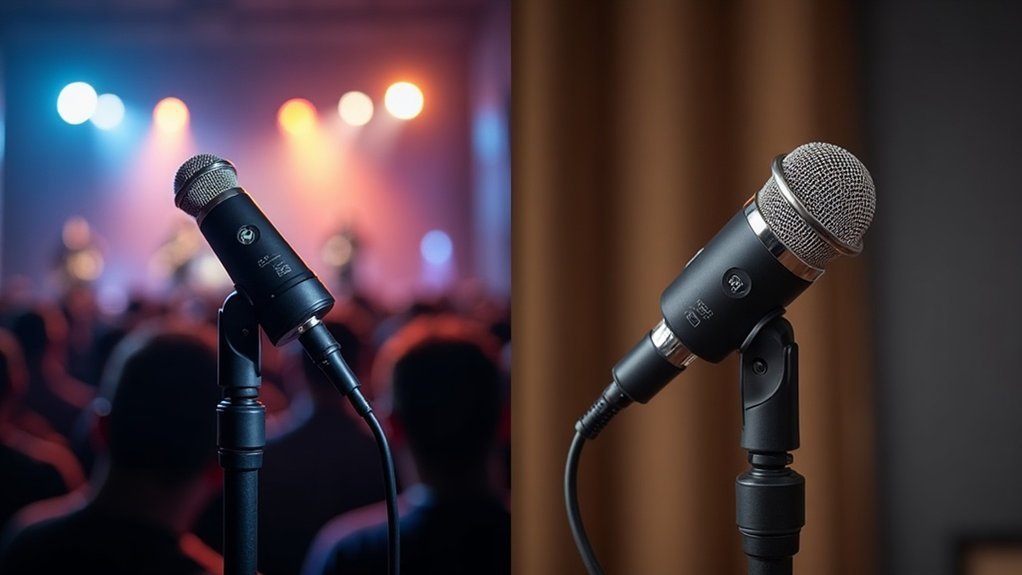
On live stages, supercardioid balances directionality with usability, delivering strong feedback management and side rejection without punishing placement errors. Hypercardioid dominates aggressive stage environments demanding maximum sound isolation. When comparing live stages versus studios, recognize that stage conditions require pattern selection prioritizing real-world performance stability. Vocal performers particularly benefit from supercardioid’s forgiving proximity tolerance during live performance. Monitor placement significantly impacts feedback potential, making careful angling and positioning crucial for stage success. Supercardioid’s narrower front pickup compared to cardioid makes it especially effective for isolating lead vocals from surrounding instruments on crowded stages. The cardioid pickup pattern serves as a reference point for understanding how supercardioid and hypercardioid patterns refine directional sensitivity for specific stage demands.
Studio Considerations
Studios present different demands than live venues. Supercardioid reduces room noise in semi-treated spaces, while hypercardioid targets side reflection rejection. Both patterns’ rear lobes complicate reflective rooms. The distinction between stages and studios becomes clear when you examine how each environment’s acoustics interact with microphone polar patterns. In controlled studio settings, your pattern choice directly impacts whether you’re capturing natural room character or isolating source material.
Decision Framework
Your decision hinges on whether you’re prioritizing feedback control or capturing natural room character. Where live stages vs. studios differ most is in their tolerance for rear lobe sensitivity and placement flexibility.
| Environment | Best Pattern | Priority |
|---|---|---|
| Live Vocal Stage | Supercardioid | Feedback Management |
| Crowded Stage | Hypercardioid | Sound Isolation |
| Studio Recording | Supercardioid | Room Noise Reduction |
Supercardioid or Hypercardioid: How to Choose?
Supercardioid microphones excel when your primary concern is minimizing what the mic picks up from directly behind you. Both supercardioid and hypercardioid patterns exhibit proximity effect, which causes increased bass response when the sound source is positioned very close to the microphone. Supercardioid microphones often balance ambient rejection with focused sound pickup, making them versatile for various recording situations. The hypercardioid pickup pattern offers an even more narrowed acceptance angle compared to supercardioid designs.
Pick hypercardioid when maximum side noise rejection is your priority and you can position yourself carefully relative to the mic.
Hypercardioid options provide superior isolation from problematic side pickup, making them ideal when neighboring rooms or equipment noise threatens your recording quality.
Your supercardioid versus hypercardioid decision ultimately hinges on which acoustic threat matters most: problematic rear pickup or problematic side pickup.
Podcasters and streamers in apartment settings often favor supercardioid patterns, while musicians and gamers dealing with lateral noise sources typically benefit more from hypercardioid rejection patterns.
Match your choice to your space’s acoustic challenges for peak performance.
The right supercardioid or hypercardioid selection transforms your affordable microphone into a professional-grade tool tailored to your specific environment.