
Balanced and unbalanced audio connections differ significantly in their design and application, directly impacting your audio experience. Balanced audio connections use three conductors for improved noise rejection**, making them ideal for professional settings where signal integrity is vital. On the other hand, unbalanced audio, which employs only two conductors, is more susceptible to interference and is typically suited for shorter distances, primarily in consumer applications**.
If you’re considering the difference between balanced and unbalanced audio, think about your specific environment and cable length. Understanding these distinctions can greatly enhance your audio system’s performance. Additionally, exploring the types of connectors and how cables affect audio quality can further inform your choices. Ultimately, knowing the nuances between balanced and unbalanced audio will help you make the best decision for your podcasting, streaming, or recording needs.
Key Takeaways
- Connection Type: Balanced connections use three conductors, while unbalanced connections utilize two conductors, affecting signal integrity and noise susceptibility.
- Noise Rejection: Balanced connections employ differential signaling for superior noise immunity, while unbalanced connections are more prone to interference and noise.
- Distance Suitability: Balanced cables are ideal for runs over 15 feet in high-noise environments, whereas unbalanced cables work best for shorter distances under 10 feet.
- Connector Types: Common connectors include XLR for balanced signals and TS or RCA for unbalanced signals, each suited for specific applications.
- Cost Considerations: Balanced cables tend to be more expensive but offer better performance, while unbalanced cables are more affordable for casual audio setups.
What Are Balanced and Unbalanced Audio Connections?
What Are Balanced and Unbalanced Audio Connections?
When it comes to audio connections, understanding the difference between balanced and unbalanced audio connections is crucial. Balanced audio connections utilize three conductors to enhance signal integrity, providing notable advantages such as improved audio fidelity and reduced ground loops. By employing cable shielding and impedance matching, they effectively minimize interference, making balanced connections ideal for professional settings. This is especially important in environments where signal integrity must be preserved over long distances. Additionally, balanced connections utilize a second signal wire for an inverted copy of the first, resulting in enhanced noise cancellation. In contrast, balanced connections are often necessary in scenarios where mic level signals are involved, as they can maintain clarity and quality.
On the other hand, unbalanced audio connections, which feature a two-conductor setup, are more susceptible to noise and signal degradation over distance. While unbalanced systems are commonly found in consumer audio applications, balanced audio connections shine in situations that demand high-quality sound transmission, ensuring greater reliability and performance.
Whether you’re a creator, gamer, or musician, knowing about balanced and unbalanced audio connections can help you make informed choices for your podcasting, streaming, and recording needs.
How Do Balanced Connections Reject Noise Effectively?
Balanced connections reject noise effectively through a combination of differential signaling and common-mode rejection techniques. By utilizing two conductors that carry identical audio signals of opposite polarity, these balanced cables significantly enhance noise immunity. The cable geometry ensures equal exposure to potential interference, allowing common-mode noise to cancel out via phase cancellation. At the receiving end, differential amplifiers emphasize the voltage difference, which greatly improves signal integrity. With a Common-Mode Rejection Ratio (CMRR) typically around 40–60 dB, balanced connections achieve impressive interference reduction, effectively preserving audio fidelity. This meticulous design not only fosters a clean sound experience but also makes it ideal for creators, gamers, and musicians working in challenging environments, especially since shielded cables provide better noise rejection.
When Should You Choose Balanced or Unbalanced Audio Cables?
When you’re deciding between balanced and unbalanced audio cables, consider the length of your cable run and the environment. Balanced cables excel in long runs and high-noise areas, ensuring signal integrity. Additionally, they are better at rejecting interference noise than unbalanced cables, making them ideal for professional audio setups. However, if you’re on a budget and working with short connections in quiet spaces, unbalanced cables may suffice. Balanced cables maintain a clean signal over 300 feet, which is crucial for avoiding signal degradation in extensive setups.
Long Cable Runs
Choosing the right audio cable for long cable runs can greatly impact your sound quality. For ideal signal integrity considerations in long cable runs, consider these strategies:
- Use balanced cables for runs exceeding 20 feet to minimize noise interference, especially in long cable runs. This is because balanced cables can support longer distances without significant signal degradation.
- Choose balanced connections when routing audio between separated equipment areas, as this is crucial for effective long cable runs.
- Opt for balanced cables when the source and destination both support balanced inputs and outputs, ensuring the integrity of your long cable runs.
- Always select balanced options for runs across rooms or stages, guaranteeing consistent performance during long cable runs. Additionally, using common-mode rejection can help enhance the effectiveness of your balanced connections in noisy environments.
High-Noise Environments
In high-noise environments, selecting the right audio cable becomes critical for maintaining sound quality. When you’re working in high-noise environments, balanced cables excel in noise isolation, providing 40–60 dB common-mode noise rejection against interference sources like lighting and power infrastructure. This is particularly important because balanced cables provide stronger audio signals with less extraneous noise, making them ideal for longer distances. Additionally, differential signaling in balanced systems effectively cancels out external noise, enhancing overall audio clarity.
For professional audio, always opt for balanced connections in venues with high EMI/RFI to preserve signal integrity. Unbalanced cables, acting as antennas, are vulnerable to hum and buzz, especially over longer distances. Moreover, a higher signal to noise ratio ensures that desired audio signals remain clear and prominent, even amidst competing noise.
When dealing with low-level signals in these high-noise environments, balanced lines are essential to mitigate interference. Prioritizing balanced options guarantees peak performance in demanding environments, making it the standard for pro audio, live sound, and broadcast applications.
Budget Considerations
Budget Considerations
When it comes to budget considerations for audio cables, the choice between balanced and unbalanced options is critical. For ideal budget efficiency, keep the following factors in mind during your cost analysis:
- Cable Length: Opt for unbalanced cables for runs under 10 feet, as they tend to be more affordable.
- Equipment Compatibility: Ensure your gear supports balanced inputs; if it doesn’t, unbalanced cables are the more economical choice.
- Use Case: For casual listening environments, unbalanced options are sufficient; however, balanced cables are ideal for professional audio settings.
- Long Runs: When dealing with distances over 15 feet, investing in balanced cables is wise to reduce noise and future troubleshooting costs.
What Types of Connectors Are Commonly Used?
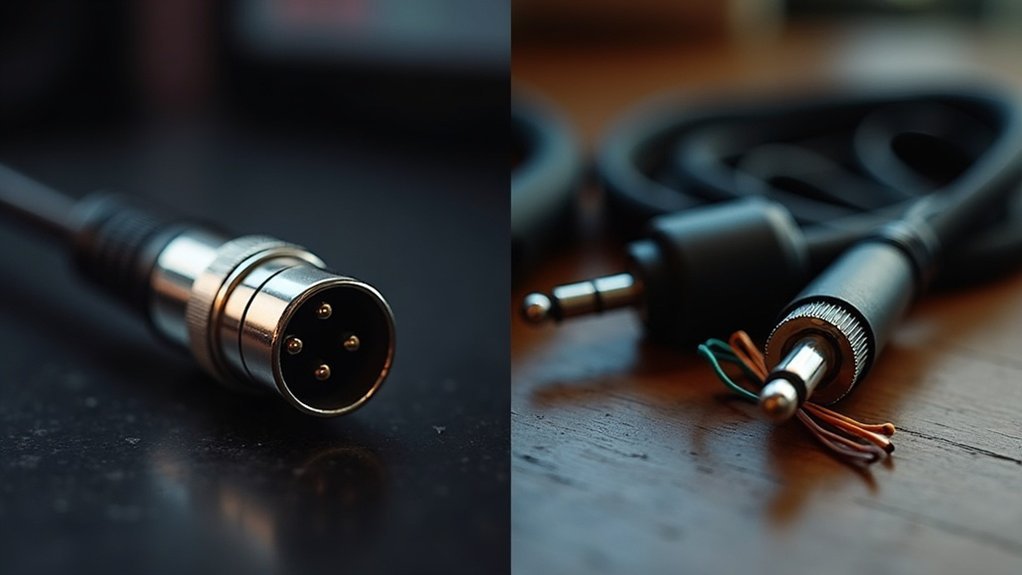
When you’re working with audio equipment, understanding common connectors is essential. XLR connectors are standard for balanced applications, while TRS and TS types serve various roles in both balanced and unbalanced setups. Additionally, RCA connectors are prevalent in consumer audio, making them vital for everyday connections. TRS connectors are particularly useful for balanced audio connections, helping to reduce noise and interference.
XLR Connectors Overview
Here are some key points regarding XLR connectors:
- 3-pin XLR: This is standard for microphones and line-level interconnects, making it essential for podcasting and streaming.
- 4-pin XLR: Common in broadcast and intercom applications, these connectors are often used in professional environments.
- 5-pin XLR: Utilized for DMX512 digital lighting control and stereo microphones, they play a significant role in live performances.
- Multi-pin variants: These support complex audio and power applications, ensuring versatility for creators and musicians.
These XLR connectors guarantee secure connections and reliable signal flow, which is essential in both studio and live environments. Additionally, understanding how XLR microphones connect can enhance your audio setup and improve overall sound quality.
Understanding the XLR connectors overview can help creators, gamers, and professionals make informed decisions about their audio equipment, ensuring they achieve the best possible results in their projects.
TRS and TS Types
TS connectors are primarily used in unbalanced mono applications, such as electric guitars and keyboards, where they carry one signal plus ground.
In contrast, TRS connectors facilitate balanced mono or unbalanced stereo signals, offering noise rejection for longer runs.
You’ll often find TRS usage in professional audio setups, including mixers and headphone outputs. Additionally, TRS connectors are essential for applications requiring both audio and microphone signals, like headsets.
Recognizing these distinctions between TRS and TS types helps you choose the right connector for your audio needs and enhances your overall sound experience.
Whether you’re a gamer, musician, or podcaster, knowing the nuances of TRS and TS types can significantly impact your audio quality and performance.
RCA Connector Usage
RCA connectors are ubiquitous in both audio and video applications, and understanding the various types of RCA connectors can significantly enhance your setup. By familiarizing yourself with these RCA connector types, you can optimize your audio and video experiences.
Here are some common RCA cable applications:
- Stereo RCA: Ideal for transmitting left and right audio channels in devices such as CD players and TVs, making them essential for any audio setup.
- Mono RCA: Used for single-channel audio, particularly in vintage systems and musical instruments, ensuring clarity in sound.
- Subwoofer RCA: Specifically designed for low-frequency effects in surround sound setups, these connectors play a crucial role in delivering rich bass.
- Digital Coaxial RCA: This type is perfect for multi-channel digital audio formats like Dolby Digital, making it a staple in modern audio configurations.
Understanding RCA connector usage is essential for anyone looking to enhance their audio and video setups. These connectors guarantee reliable signal transmission for all your audio and video needs, ensuring you get the best performance from your equipment.
How Cable Length Affects Audio Quality
As cable length affects audio quality, it directly impacts the integrity of your sound through several electrical properties that can degrade the signal. Increased cable resistance leads to signal attenuation, compromising audio clarity, especially over long distances.
Additionally, longer cables exhibit higher capacitance, which can form low-pass filters that diminish high-frequency content, while increased inductance subtly alters phase response. Moreover, longer cables act as larger antennas, making them more susceptible to interference from electromagnetic interference (EMI) and radio frequency interference (RFI).
In typical setups, it’s advisable to keep speaker cables under 8–10 ft and unbalanced interconnects below 20 ft to minimize signal degradation.
Essential Factors for Designing Balanced and Unbalanced Audio Systems
Understanding the impact of cable length on audio quality is crucial for designing balanced and unbalanced audio systems. When considering audio systems, here are essential factors to keep in mind:
- Impedance Matching: Ensure that output and input impedances are aligned to maximize performance in both balanced and unbalanced configurations.
- Noise Interference: Implement balanced designs to significantly reduce susceptibility to hum and RF interference, enhancing the overall audio experience.
- Grounding Practices: Adopting proper grounding techniques is vital to mitigate ground loops, particularly in balanced systems.
- Component Selection: Opt for differential amplifiers early in the signal chain to boost noise rejection, especially important in balanced audio systems.