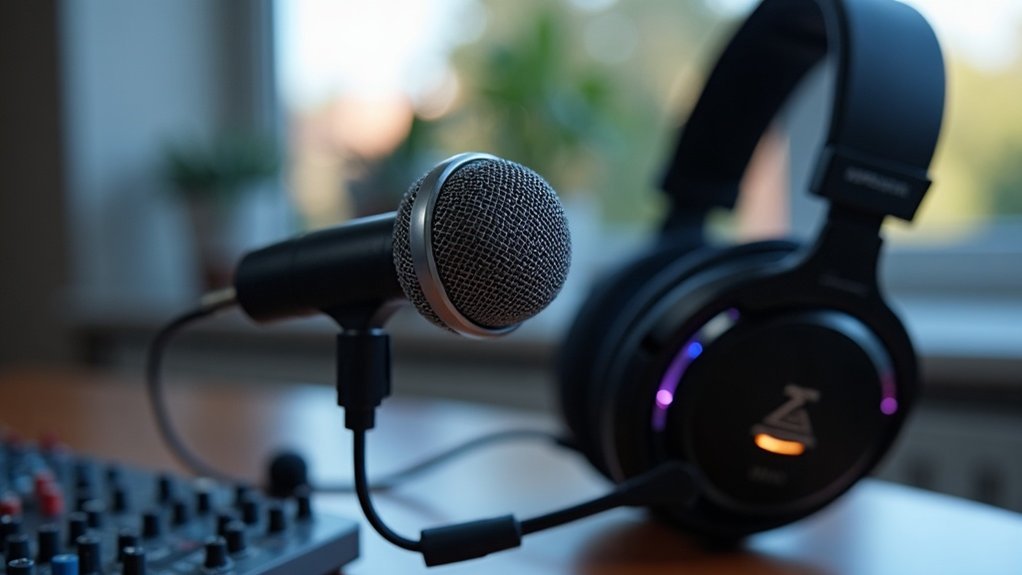
Can you use a gaming headset mic for podcasting? Yes, but you’re accepting significant tradeoffs. Gaming headset mics capture narrower frequency response (100–10 kHz versus 20–20 kHz for dedicated podcast mics) and produce thinner audio with lower clarity scores (6.2/10 versus 8.9/10). They’re suitable for casual content, online education, or budget setups where intelligibility matters more than broadcast-grade polish.
When considering whether a gaming headset microphone works for podcasting, recognize that heavy noise suppression sacrifices vocal detail. However, strategic mic positioning and gain adjustment help mitigate these limitations. Using a gaming headset mic for podcasting requires understanding your specific use case—whether the convenience of an all-in-one gaming headset justifies the audio quality compromise compared to dedicated podcast equipment.
For creators on a budget, a gaming headset mic for podcasting can serve as a stepping stone before investing in professional-grade gear. This approach works well for streamers transitioning into podcast production or gamers launching audio content alongside their streams. The real question isn’t whether you *can* use a gaming headset mic for podcasting, but whether your audience expectations and content goals align with its limitations. Budget-conscious podcasters often find gaming headset alternatives acceptable for episodic content, though growth typically demands an upgrade to specialized microphones designed specifically for voice recording and podcast production.
Key Takeaways
- Gaming headset mics are acceptable for beginner podcasts but require aggressive audio editing to achieve professional-quality sound.
- Gaming headsets capture narrower frequency response (100–10 kHz) compared to dedicated mics (20–20 kHz), resulting in thinner audio.
- Close boom mic placement minimizes room noise and enhances speech intelligibility, making them suitable for budget-conscious creators.
- Heavy noise-suppression processing can sacrifice vocal detail; dedicated microphones preserve breath texture and sibilance better for clarity.
- Upgrade to dedicated microphones for monetized shows, multi-voice recordings, or regular publishing where polished sound impacts brand perception.
Can You Use a Gaming Headset for Podcasting?
Yes, you can use a gaming headset for podcasting, but you’ll encounter a notable audio quality tradeoff. The question of whether gaming headsets work for podcasting often comes down to your priorities and budget constraints.
Gaming headset microphones prioritize communication over high-fidelity voice capture, typically producing thinner, more nasal sound than dedicated podcast microphones. While acceptable for beginner podcast formats and casual recordings, using a gaming headset for podcasting requires more aggressive audio editing to achieve professional polish. Many gaming headsets offer multiple connection options like Bluetooth, 2.4GHz, and 3.5mm, which provides flexibility for different recording setups.
You’ll notice bass-heavy tuning and exaggerated treble that complicate accurate monitoring. For quick setup workflows where simplicity matters most, a gaming headset works adequately for initial experiments with podcasting. Even with unprocessed audio, authenticity is valued and decent sound remains achievable through proper technique and microphone placement.
However, when vocal clarity becomes your priority, upgrading to a standalone studio microphone paired with closed-back monitoring headphones delivers superior long-term results. Selecting the right microphone based on your singing voice characteristics ensures that your podcast captures the nuances of your vocal performance. Many affordable podcast microphones on the market now offer professional-grade performance without breaking the bank, making the transition from gaming headset to dedicated equipment increasingly practical for serious content creators.
The distinction between gaming headsets and podcast-specific gear ultimately reflects different design philosophies. If you’re serious about podcasting quality while still maintaining gaming versatility, consider investing in a hybrid approach: a quality standalone microphone for recording content, paired with your existing gaming headset for monitoring during streams or gaming sessions.
Why Gaming Headsets Work for Voice Recording
When you position a gaming headset’s boom mic near your mouth, you’re capturing your voice at high signal strength while minimizing room noise and keyboard clatter—a setup that translates directly to clearer podcast recordings.
The microphone’s design prioritizes voice frequencies over ambient sound, which means you’re working with hardware already tuned for the intelligibility requirements of speech communication.
This close-proximity capture, combined with the headset’s voice-chat optimization, gives you a foundational advantage for recording spoken content without requiring additional microphone equipment. Many gaming headsets offer noise reduction processing designed specifically for multiplayer communication, which can significantly enhance audio clarity during your recording sessions. For optimal results, utilize noise-cancellation features to further reduce background interference during your podcast sessions.
Close Proximity To Mouth
Gaming headset microphones work effectively for voice recording largely because of their close proximity to mouth—positioned just 1–2 inches from the corner of your mouth, a distance that keeps your vocal signal strong without requiring excessive gain.
This close proximity to the mouth creates several advantages:
- Captures more direct vocal energy while rejecting room sound
- Maintains your voice in the mic’s near field, where speech dominates background noise
- Reduces plosive and breath noise through off-axis positioning
- Eliminates aggressive software gain that amplifies unwanted room noise
- Preserves vocal clarity at typical speaking levels without distortion
The proximity to mouth advantage is why gaming headsets excel as affordable microphone solutions for podcasting and streaming.
When a microphone maintains this close mouth proximity, it naturally rejects background noise and room reflections—critical factors for creators on a budget who can’t invest in treated studio spaces. Since microphone placement shapes about 20% of recording sound quality, the strategic positioning of gaming headset mics near the mouth significantly enhances overall audio performance. Gaming headsets typically employ cardioid pickup patterns that further enhance their ability to isolate your voice while minimizing ambient noise.
Side-of-mouth placement balances voice pickup with reduced air turbulence while maintaining this optimal proximity to mouth.
For gamers, musicians, and content creators seeking affordable microphones for streaming or podcasting, the close proximity to mouth design of gaming headsets offers surprising professional capabilities without the expense of traditional studio gear.
This positioning principle is fundamental to understanding why budget-friendly gaming headsets often outperform higher-priced alternatives lacking this strategic mouth proximity advantage.
Built-In Voice Chat Design
Beyond the microphone’s distance from your mouth, the integrated design of gaming headset mics fundamentally shapes their recording capabilities for built-in voice chat. Manufacturers engineer the mic, cable routing, and acoustic path as one cohesive system, enabling precise mic optimization during development.
This integrated design for built-in voice chat systems eliminates loose connectors and mismatched components that degrade audio quality. Cardioid tuning and noise isolation features suppress ambient sound, prioritizing speech intelligibility over studio fidelity. The SteelSeries Arctis Nova 5X exemplifies this approach with its retractable built-in mic that enhances both convenience and audio performance. Models equipped with bendable boom mic with dual mics technology further improve clarity during voice transmission.
The acoustic path is tuned specifically for voice pickup during real-time communication—your built-in voice chat gaming priorities align perfectly with podcast recording needs. Built-in convenience features like mic mute and monitoring controls streamline workflows, making these voice chat-equipped headsets practical for spoken-word content creation.
Whether you’re prioritizing clear team communication or doubling your headset as a recording tool, understanding how built-in voice chat design impacts audio quality helps you make informed purchasing decisions that serve both gaming and content creation.
Gaming Headset vs. Dedicated Mic: Sound Quality Compared
When you compare a gaming headset mic to a dedicated podcast microphone, you’ll notice significant differences in clarity and tonal range. Gaming mics typically capture a narrower frequency response that produces thinner, more compressed audio, while dedicated mics preserve fuller vocal resonance and natural detail across a wider spectrum.
Your choice between them also hinges on noise handling capabilities: headset mics excel at rejecting ambient sound through close proximity and directional pickup patterns, but dedicated mics offer superior flexibility in polar pattern selection and room treatment to achieve professional-grade isolation. USB condensers feature larger diaphragms and better analog-to-digital converters that enable them to capture nuanced vocal characteristics gaming headsets simply cannot reproduce. Dedicated mics are particularly advantageous because they include enhanced noise isolation that significantly reduces background interference during recording. Condenser microphones are especially well-suited for podcast production because their design captures the vocal clarity necessary for engaging listener experiences.
Ultimately, professional broadcast standards favor dedicated microphones because they deliver the higher-definition raw signal and lower noise floor that reduce your post-production workload and establish credibility with your audience.
Clarity And Tonal Range
Because frequency response directly shapes clarity and tonal range—the foundation of professional audio—the differences between gaming headset mics and dedicated condenser mics become immediately apparent in side-by-side listening.
Gaming headset mics typically operate within 100–10 kHz, while dedicated condensers span 20–20 kHz. This gap in tonal range creates measurable clarity enhancements in dedicated mics:
- Vocal clarity scores: 8.9/10 (dedicated) vs. 6.2/10 (gaming headset)
- Breath texture and sibilance preservation in standalone mics
- Tonal adjustments favoring natural resonance over speech intelligibility alone
- Larger diaphragms capturing harmonic fullness absent in headsets
- Dynamic range superiority (90+ dB vs. 70–80 dB) preserving vocal nuance and tonal character
For creators investing in affordable microphones for podcasting and streaming, understanding clarity and tonal range separates budget-friendly options from genuinely professional equipment. Condenser microphones excel in capturing detailed frequency information due to their sensitive diaphragm design, making them the industry standard for podcast recording. The server-side rendering configuration used in modern content delivery systems ensures that audio specifications and technical comparisons load reliably across all user devices.
You’ll notice dedicated mics deliver noticeably richer, more professional vocal reproduction—essential for podcast credibility and audience retention.
The expanded frequency response and tonal range of condensers directly translates to broadcast-quality sound that elevates your content across gaming streams, music recording, and professional voice work.
Noise Handling Capabilities
Noise rejection—the ability to isolate your voice while suppressing unwanted room sound—reveals a fundamental tradeoff between gaming headsets and dedicated podcast microphones.
Gaming headsets excel through close placement, cardioid patterns, and aggressive noise-suppression processing that prioritizes real-time clarity. However, that same processing often sacrifices vocal detail and can introduce artifacts like thinness or pumping.
When evaluating noise handling capabilities, dedicated mics manage ambient sound more cleanly by capturing fuller frequency response and relying on placement and polar patterns rather than heavy filtering. The choice between standalone microphones and headsets fundamentally depends on whether your priority is convenience or audio fidelity.
Your noise handling capabilities directly impact whether your content sounds like a rough draft or professional broadcast—a critical distinction for streamers, podcasters, and gaming streamers building audience trust.
Understanding noise handling capabilities means recognizing that headsets accept background interference as a tradeoff for convenience, while dedicated microphones preserve the usable vocal detail you need for broadcast-quality podcast masters.
For creators investing in affordable microphones for podcasting and streaming setups, superior noise handling capabilities translate to fewer retakes, cleaner audio in post-production, and content that stands up to professional scrutiny.
Whether you’re recording gaming commentary, podcast episodes, or music, your microphone’s noise handling capabilities determine whether listeners focus on your message or your environment.
Professional Broadcast Standards
Broadcast standards demand:
- Stable positioning via boom arms—headsets shift with head movement, creating inconsistent capture
- Full frequency response (20 Hz–20 kHz) instead of voice-limited ranges (300 Hz–10 kHz)
- Superior dynamic range and linearity for nuanced vocal detail across dynamic ranges
- Low-end warmth and midrange clarity that headset compression eliminates
- Transient handling that preserves natural vocal realism
Gaming headsets prioritize speech detection over audio fidelity. Understanding frequency response characteristics helps explain why dedicated mics outperform gaming headsets across technical specifications. When comparing affordable microphones for podcasting, you’ll find that dedicated mics outperform gaming headsets on every technical metric. An affordable microphone for podcasting delivers the best affordable microphone for podcasting performance by offering true condenser or dynamic capsule technology rather than gaming-optimized compression algorithms.
To meet professional broadcast standards and deliver the polished audio your audience expects, invest in a dedicated best affordable microphone for podcasting rather than relying on headset solutions. This upgrade ensures your content matches listener expectations for professional audio quality across all platforms.
Best Podcasting Scenarios for Your Gaming Headset
Online education and webinar delivery benefit from their clarity and unobstructed camera placement, making them practical choices within the broader range of best scenarios for podcasting with gaming headsets**. Budget setups and travel-friendly configurations** leverage their portability, appealing to creators transitioning from casual streaming to podcast production without significant investment.
Success in these ideal podcasting scenarios for gaming headsets depends on controlling your recording environment through basic noise control and acoustic treatment. Cardioid patterns reject off-axis noise effectively, ensuring usable results across varied acoustic spaces without complex post-production demands. Understanding microphone types helps creators make informed decisions when comparing gaming headsets against other audio equipment options.
When you identify which podcasting scenario works best for your gaming headset, you can optimize placement and gain settings accordingly.
The key distinction: while gaming headsets won’t replace dedicated podcast microphones in professional broadcast contexts, they deliver reliable performance across these best practical podcasting scenarios for gaming headsets where convenience and consistent voice capture outweigh the need for broadcast-grade audio. This makes them valuable tools for creators evaluating affordable microphone solutions across every stage of the production journey.
When to Upgrade From a Gaming Headset Mic
- Multi-voice recordings expose room reflections and crosstalk that isolate voices poorly.
- Crackling, muffled audio, or inconsistent gain becomes editing bottlenecks.
- Public or monetized shows demand polished sound that affects brand perception.
- XLR compatibility becomes essential for multi-mic expansion and long-term flexibility.
- Regular publishing makes headset compromise feel restrictive rather than functional.
Understanding when you should upgrade from your gaming headset mic requires honest assessment of your show’s growth trajectory. The transition from gaming headset microphone to dedicated podcast equipment represents a professional shift—not just a gear swap. Unlike gaming headsets designed for communication, dynamic microphones are engineered to capture vocal nuance and reject ambient noise, making them better suited for professional podcast production.
The shift from gaming headset to dedicated podcast gear marks a professional evolution, not merely equipment replacement.
Once listeners expect presence and depth, or your show demands independent gain control across speakers, upgrading from a gaming headset mic to a dedicated podcast microphone justifies the investment.
This upgrade path applies whether you’re expanding from streaming into podcasting, scaling multi-guest interviews, or monetizing content where audio quality directly impacts listener retention and sponsorship viability.
The moment your current gaming headset begins limiting rather than enabling your creative output is precisely when to upgrade from a gaming headset mic to equipment built specifically for sustained production.
How to Maximize Your Gaming Headset Mic Quality
Five critical adjustments separate mediocre audio from podcast-ready sound when you’re working with a gaming headset mic. To truly maximize your gaming headset mic quality, start with mic positioning—place the boom 1–2 inches from your mouth corner, angled slightly off-axis to minimize plosives. This foundational step is essential for anyone serious about maximizing gaming headset mic quality for streaming or content creation. Gaming headsets typically feature omnidirectional pickup patterns that capture sound from all directions, so careful positioning becomes even more critical to isolate your voice from background noise.
Set input gain between -12 dB and -6 dB for normal speech, keeping peaks near -3 dB. This level of precision helps you maximize your gaming headset mic quality across different recording environments.
Enable noise suppression through Krisp or RTX Voice, then apply a high-pass filter at 80–100 Hz to further enhance your setup’s ability to maximize gaming headset mic quality.
For sound isolation, reduce nearby fans and mechanical keyboards—two of the most common culprits undermining mic quality. Monitor with headphones to eliminate speaker bleed, ensuring your efforts to maximize your gaming headset mic quality aren’t sabotaged by ambient noise.
Record test clips before each session to verify placement and levels remain consistent, giving you reliable feedback on whether your adjustments are successfully maximizing your gaming headset mic quality for your specific streaming or recording needs.
Budget-Friendly Podcast Microphone Upgrades
Once you’ve dialed in your gaming headset mic‘s positioning and gain settings, you’ll quickly discover the ceiling of what that entry-level hardware can deliver.
Budget-friendly podcast microphone upgrades open up professional-grade sound quality without breaking your budget. Strategic equipment choices enable creators and gamers to achieve podcast-quality audio through smart, affordable improvements.
Strategic equipment choices enable creators and gamers to achieve podcast-quality audio through smart, affordable improvements without breaking the budget.
Budget-friendly podcast essentials for microphone upgrades:
- Dual-output microphone types (USB + XLR) eliminate future replacement costs and support budget-friendly podcast microphone progression.
- Entry level mics like Samson Q2U ($60–$70) deliver the foundation for affordable podcast microphone upgrades.
- Audio interfaces expand your recording techniques beyond basic USB connectivity, essential for budget podcast setups.
- A USB audio interface serves as the bridge between your microphone and computer, enabling professional-grade recording capabilities in your home studio.
- Room treatment outperforms expensive microphones in untreated spaces—the smartest budget-friendly podcast investment.
- Pop filters and shock mounts ($15–$30) greatly reduce plosive artifacts without expensive gear.
The $70–$130 sweet spot delivers dynamic USB options with professional potential, letting you invest remaining budget toward acoustic treatment.
This approach to budget-friendly podcast microphone upgrades proves that affordable doesn’t mean compromised. By prioritizing strategic upgrades over costly gear, creators and gamers can build podcast microphone setups that rival expensive investments while maintaining financial flexibility for future enhancements.
Your Decision Checklist: Headset or Dedicated Mic
Reserve headsets for rough drafts, backup interviews, or internal notes—their flexibility serves specific workflow stages rather than primary content production.
When weighing your headset or mic decision, consider that many affordable microphones now rival expensive dedicated setups, making the traditional headset-or-dedicated-mic debate more nuanced than ever. Streaming, gaming, and podcast recording all benefit from understanding when your headset vs. mic selection truly matters. Unlike gaming headsets, dynamic microphones deliver superior performance for professional vocal recording applications.
When professionalism matters, dedicated equipment delivers the sonic credibility your audience deserves. Yet the right answer to your headset or dedicated microphone question depends on your specific use case, budget constraints, and production goals—not blanket industry standards.