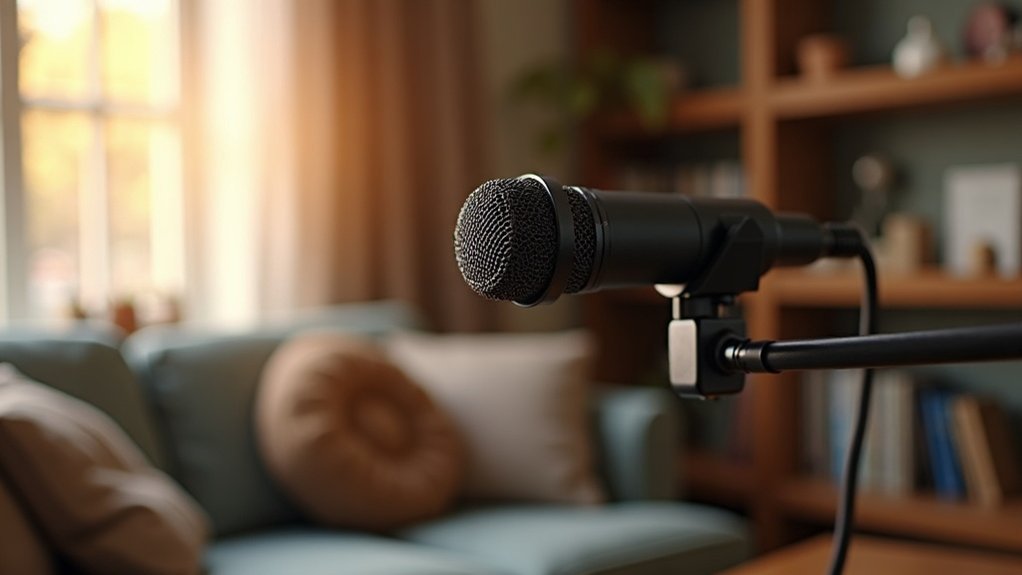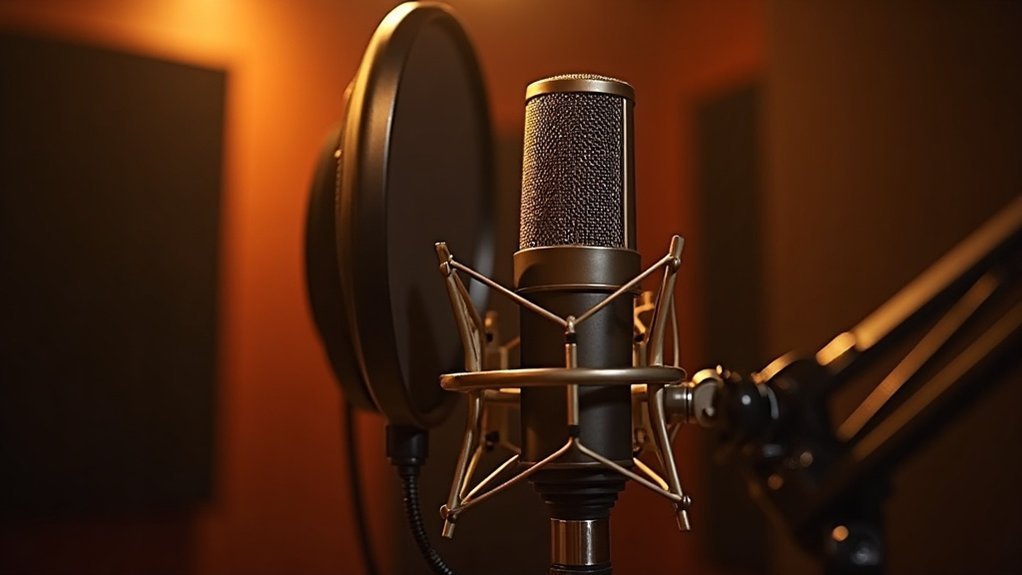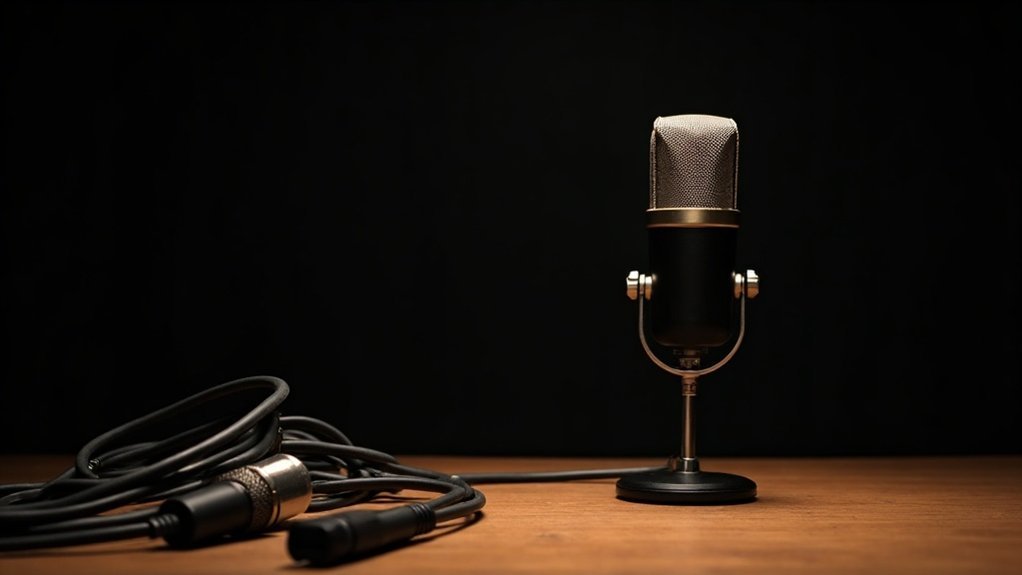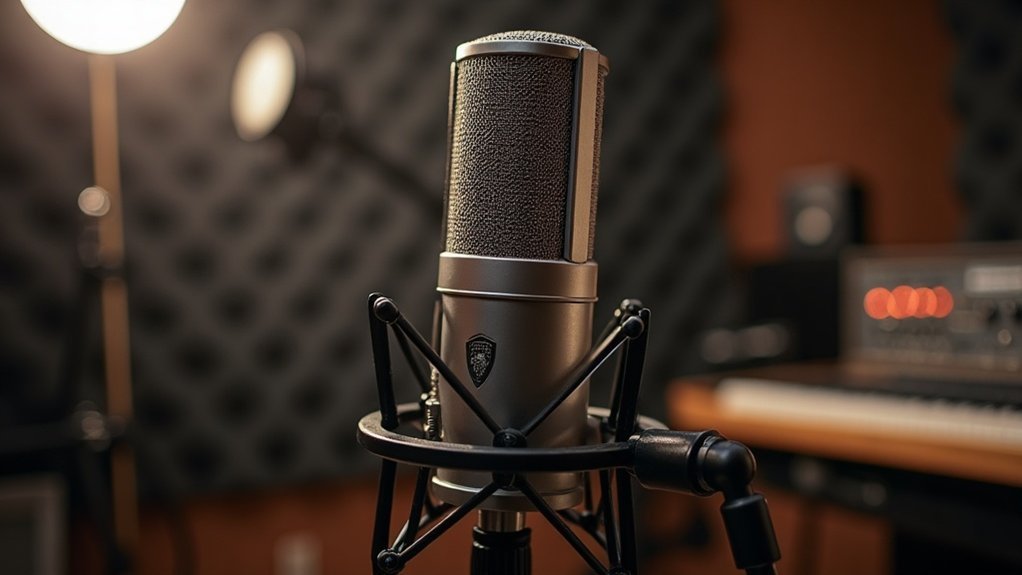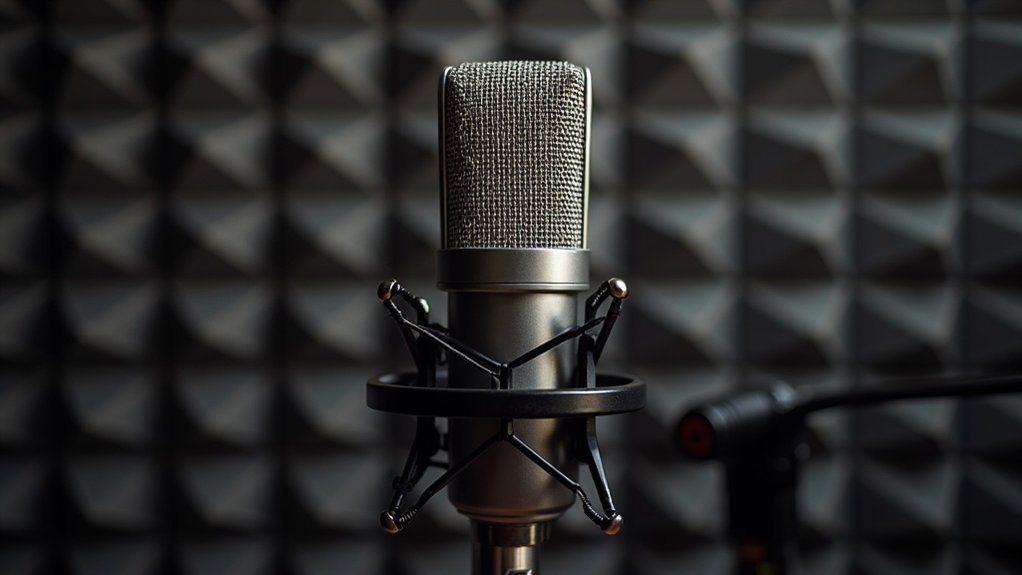
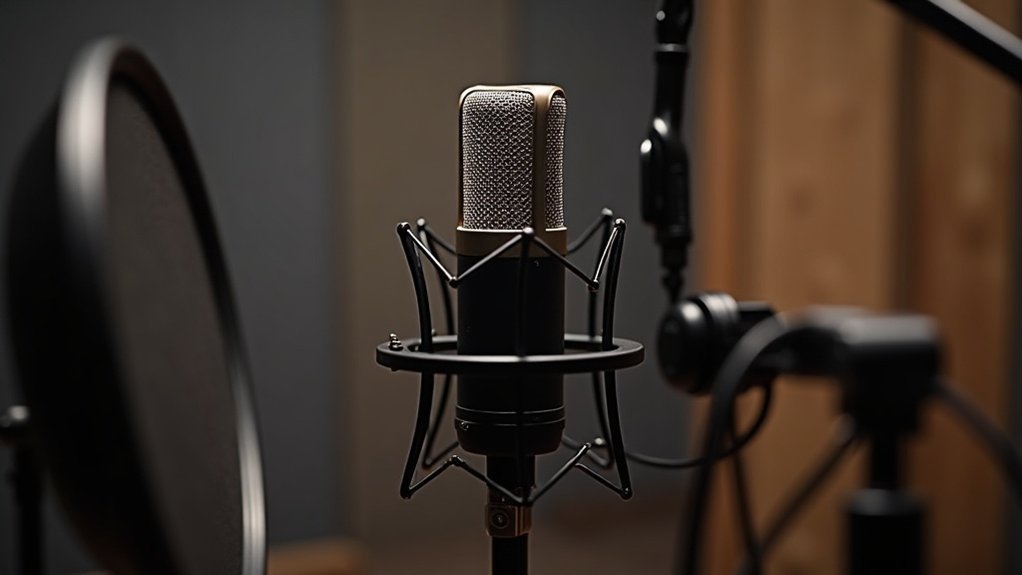
When determining which microphone is good for singing, you’ll need either a dynamic microphone for live performance durability or a condenser mic for studio vocal detail. Dynamic mics excel at feedback rejection and stage reliability, while large-diaphragm condensers capture nuanced vocal frequencies with superior sensitivity.
Finding the right microphone that’s good for singing requires evaluating your voice type, recording environment, and budget—factors that greatly impact frequency response and self-noise performance. Whether you’re a podcaster, streamer, or recording artist, understanding how these elements interact is essential for selecting a good singing microphone that truly suits your specific application.
For those exploring good microphones for singing across different price points, dynamic options like the SM7B deliver professional-grade feedback rejection ideal for live vocals, while budget-friendly condensers offer studio-quality vocal capture without breaking the bank. Understanding these distinctions helps musicians and content creators identify which microphone works best for their unique singing style and recording setup.
Key Takeaways
- Large-diaphragm cardioid condensers capture vocal nuances with clarity, making them the standard for professional singing recordings.
- Test microphones with your specific voice type to ensure optimal frequency response and tonal characteristics for your range.
- Dynamic microphones suit live singing performances, offering feedback rejection and durability despite less pristine detail capture than condensers.
- Studio singing benefits from low self-noise microphones in acoustically treated environments for superior detail and smooth frequency response.
- Budget $150–$300 for quality singing mics; the AT2020 and AT2035 offer excellent vocal clarity across different price tiers.
Choose Your Singing Path: Live Performance or Studio Recording
Because live performance and studio recording demand fundamentally different microphone characteristics, you’ll want to assess your primary use case before investing in a vocal mic. This decision—choosing your singing path between live performance or studio recording—is one of the most critical you’ll make as a vocalist.
Live stages require dynamic cardioids that reject feedback and withstand rough handling—prioritizing your performance tips and stage reliability over pristine detail. When choosing your singing path toward live work, wireless freedom and feedback rejection become non-negotiable. Hyper-cardioid patterns like those found in the Beyerdynamic M88 excel at rejecting unwanted noise in challenging stage environments. The supercardioid pickup patterns used in premium microphones like the Telefunken M80 further enhance rejection of ambient noise while maintaining vocal clarity. Dynamic microphones are particularly favored in live settings due to their durability and natural feedback rejection capabilities.
Live performance demands dynamic cardioids that reject feedback and enable wireless freedom—prioritizing stage reliability over pristine detail.
Studio environments, by contrast, favor condensers that capture nuanced vocal techniques, breath texture, and tonal clarity in controlled acoustic spaces. If your singing path leads to studio recording, stationary precision and detail capture take priority.
Your choice shapes everything: wireless freedom versus stationary precision, feedback rejection versus detail capture. A live performance or studio recording approach fundamentally alters your microphone requirements, budget allocation, and overall setup strategy. Understanding this distinction separates informed singers from those purchasing equipment misaligned with their actual needs.
Whether you’re building your first affordable microphone setup for streaming, recording, or live gigs, defining your singing path first ensures your microphone investment actually serves your creative goals. The mic follows naturally once you’ve honestly assessed whether your primary focus is live performance or studio recording—the foundation of every successful vocalist’s gear journey.
The Right Microphone Depends on Your Voice, Space, and Budget
You’ll need to assess your primary use case—whether you’re performing live or recording in a studio—since this determines whether you’d benefit from a dynamic microphone’s durability or a condenser’s detail capture.
Your voice type matters equally; a brilliant, agile soprano requires different frequency management than a warm baritone, and your microphone choice should complement rather than fight your natural timbre. Popular options like the AKG C 414 XL II and Neumann TLM 103 are specifically designed for vocal capture with their large diaphragm construction and warm sound characteristics. Condenser microphones are particularly effective for capturing vocal nuance and sensitivity due to their responsive diaphragm design, which is why they’re preferred for vocal recording.
Finally, you must balance sonic quality against your budget constraints, recognizing that a $100 dynamic mic in an untreated home studio often outperforms a $500 condenser in the same acoustically poor space. Proper mic placement and room acoustics are essential foundations that no amount of expensive gear can compensate for if overlooked.
Assess Your Primary Use Case
Different microphone types excel in specific contexts:
- Studio recording demands condensers with low self-noise and smooth frequency response for vocal nuance.
- Live performance requires dynamic microphones with feedback rejection and durable construction.
- Home recording benefits from microphones tolerant of untreated spaces and room reflections.
Your recording techniques and environment determine whether you need isolation or flexibility. Defining your primary use case first ensures you invest in the right tool rather than chasing features you’ll never use.
A sensitive condenser in an acoustically treated room captures detail studio professionals expect. A dynamic microphone in an untreated space provides control. Dynamic microphones are particularly robust and noise-rejecting, making them ideal for performers working in less-controlled environments. Dynamic mics work exceptionally well when you need feedback rejection capabilities that prevent unwanted amplification during live performances. Testing microphones with your specific voice type helps ensure the microphone’s frequency response complements your vocal characteristics.
For podcasters and streamers, assessing your primary use case means considering whether you’ll record in a single location or move between spaces. Gamers have different requirements than musicians; content creators often need flexibility that musicians prioritize less.
Match your primary use case first—budget and gear follow. This hierarchy prevents costly mistakes and ensures your microphone investment directly supports how you actually work, not how you imagine working.
Match Microphone To Voice Type
Within the intersection of your vocal characteristics, recording space, and financial constraints lies the ideal microphone choice when you match microphone to voice type. Your voice’s frequency response demands specific microphone types: delicate voices need condensers for brightness, while baritones benefit from dynamic mics’ warmth. Rock vocalists require high SPL tolerance; rappers prioritize plosive reduction.
When you match your microphone to voice type, performance settings dictate further decisions—studio environments favor condensers’ detail, whereas live venues demand dynamic mics’ feedback rejection. Sound isolation capabilities matter considerably in untreated spaces, making microphone-to-voice-type matching essential for creators and musicians working in less-than-ideal recording conditions. Condenser microphones require phantom power to operate, which may not always be available in live performance venues. For live vocal performances, dynamic microphones are preferred for their durability and ability to handle high volume levels without feedback issues. Dynamic microphones for vocals excel at capturing the warmth and presence needed for many singing styles while maintaining consistent performance in challenging environments.
Budget options like the SM58 deliver reliable versatility across vocal styles, proving that matching microphone types to voice types doesn’t require premium pricing.
Whether you’re podcasting, streaming, gaming, or recording music, matching your microphone to your specific voice type systematically addresses these intersecting factors rather than pursuing generic recommendations alone. This approach ensures affordable microphones perform optimally for your unique vocal characteristics and recording environment.
Balance Quality With Budget Constraints
Three overlapping factors—your budget, recording environment, and vocal characteristics—determine which microphone genuinely serves your needs when you’re working to balance quality with budget constraints.
- Under $100 establishes a practical baseline for usable vocal clarity without sacrificing core performance, making this sweet spot ideal for creators learning to balance quality with budget constraints.
- $100–$200 delivers noticeably stronger detail retention and durability for serious home-studio work, proving that balancing quality and budget constraints doesn’t mean compromising professional results.
- Budget flexibility expands your options toward condensers like the AT2020, which capture nuance in treated spaces while maintaining the balance between quality and budget constraints that matters for growing creators.
Matching mic sensitivity to your room conditions matters more than purchasing the cheapest model—a principle fundamental to balancing quality with budget constraints. The sE Electronics V7 and AKG P120 represent the practical starting point for pairing dynamic and condenser microphones across different budget tiers. High sensitivity captures audio depth accurately, making it crucial for vocal recordings where nuance significantly impacts overall performance quality. Dynamic microphones eliminate the need for external power sources, allowing you to focus your budget on microphone quality rather than additional equipment expenses.
Dynamic microphones reject ambient noise effectively in untreated spaces, while condensers excel in controlled environments. This choice directly impacts your ability to maintain quality while respecting budget constraints.
USB connectivity preserves upgrade potential without requiring immediate interface investment, letting you grow your setup strategically as your vocal recordings demand higher fidelity.
Dynamic Microphones for Live Singing: Durability Meets Feedback Control
When you’re singing live, you’ll find that dynamic microphones‘ rugged moving-coil construction withstands the physical demands of stage use—handling transport wear, repeated handling, and high sound-pressure levels without distortion.
Their cardioid and supercardioid pickup patterns actively reject off-axis sound, which means you’ll experience fewer feedback issues when wedge monitors and PA speakers surround you in loud environments.
Unlike condenser microphones, which require phantom power and are more sensitive to moisture and temperature fluctuations, dynamic microphones operate independently without external power sources, making them more reliable in unpredictable stage conditions.
This combination of durability and rejection capability makes dynamics your most practical choice for controlling both stage noise and acoustic feedback simultaneously.
Built For Stage Demands
Because live performance environments demand equipment that won’t fail under pressure, dynamic microphones have become the industry standard for stage singing. When you’re selecting a microphone built for stage demands, you’ll appreciate their dynamic durability through:
- Metal housings and reinforced grilles that withstand drops, frequent handling, and touring wear
- Cardioid patterns that reject monitor feedback and lateral noise effectively
- High SPL tolerance handling your intense vocal projection without distortion
Their simple design eliminates exposed electronics vulnerable to moisture and mishandling.
You’re choosing proven reliability—models like the SM58 consistently deliver feedback management and mechanical resilience that condensers can’t match.
The cardioid pickup pattern used in most stage microphones provides superior isolation of your vocals while minimizing ambient stage noise and unwanted reflections from surrounding equipment.
For creators and performers who need equipment built for stage demands, dynamics offer unmatched dependability.
Whether you’re a touring musician, streamer, or gaming content creator performing in unpredictable environments, understanding how microphones are built for stage demands helps you make smarter purchasing decisions.
Stage performers trust dynamics because they perform predictably under demanding conditions, making them ideal across every stage of your content creation journey—from initial setup through professional touring.
Rejection In Loud Environments
Durability alone doesn’t guarantee your vocals will cut through a loud stage—you’ll also need a microphone designed for rejection in loud environments.
Cardioid and supercardioid polar patterns reject unwanted sound from the sides and rear, directly strengthening your feedback control and ensuring noise rejection in loud settings. You’re gaining practical advantages: tight pickup patterns reduce crowd noise and monitor spill, while dynamic durability withstands repeated handling.
This sound isolation matters most when monitors and PA systems sit close to your position, making environmental rejection capabilities essential for live performance.
Understanding how to achieve rejection in loud environments** starts with microphone selection. Supercardioid patterns excel at rejecting sound in loud spaces, creating a narrow pickup zone** that prioritizes your voice while minimizing stage wash and ambient noise. The supercardioid polar pattern provides even tighter rejection than cardioid designs, offering superior isolation in extremely demanding live settings.
When you’re performing in venues where acoustics work against you, sound rejection for loud environments becomes non-negotiable.
By choosing a supercardioid dynamic mic engineered for rejection in loud environments, you’re investing in both ruggedness and the acoustic isolation that keeps your vocals present and clean throughout every performance.
Whether you’re streaming, podcasting, or performing live, mastering rejection techniques in loud environments ensures your message reaches your audience without compromise.
Condenser Microphones for Studio Vocals: Detail and Sensitivity
If you’re serious about capturing professional vocal recordings, large-diaphragm cardioid condensers are the industry standard for studio work. When selecting condenser microphones for studio vocals, these instruments excel at delivering detail and sensitivity. Their thin, electrically charged diaphragms capture vocal nuances, breath, and presence with exceptional clarity. The electrically charged diaphragm is what fundamentally distinguishes condenser microphones from dynamic alternatives, enabling their superior sensitivity and frequency response.
However, this sensitivity demands careful consideration:
However, this sensitivity demands careful consideration of your recording environment and equipment specifications.
- Self-noise matters: Specs below 15 dB SPL guarantee pristine recordings without hiss
- Room acoustics shape results: Untreated spaces emphasize reflections and ambient noise
- Phantom power requirement: Most modern interfaces supply 48V seamlessly
You’ll need acoustic treatment to leverage condenser microphones for studio vocals and their inherent strengths. Their wide frequency response reproduces upper harmonics and vocal sheen that dynamic mics miss.
This detail-oriented approach—prioritizing both detail and sensitivity—defines professional studio vocals and separates affordable quality from budget equipment that fails to capture subtle vocal characteristics.
When evaluating studio vocal condensers, understand that their exceptional detail and sensitivity come with trade-offs. Your recording environment becomes critical.
These detail-oriented condenser microphones demand meticulous control, but the investment pays dividends for creators and musicians committed to professional-quality vocal recordings. Whether you’re streaming, recording podcasts, or producing music, the right studio vocal condenser with proper sensitivity management transforms your setup into a legitimate recording station rather than a compromise solution.
Best Singing Microphones by Budget: $150, $300, and $500
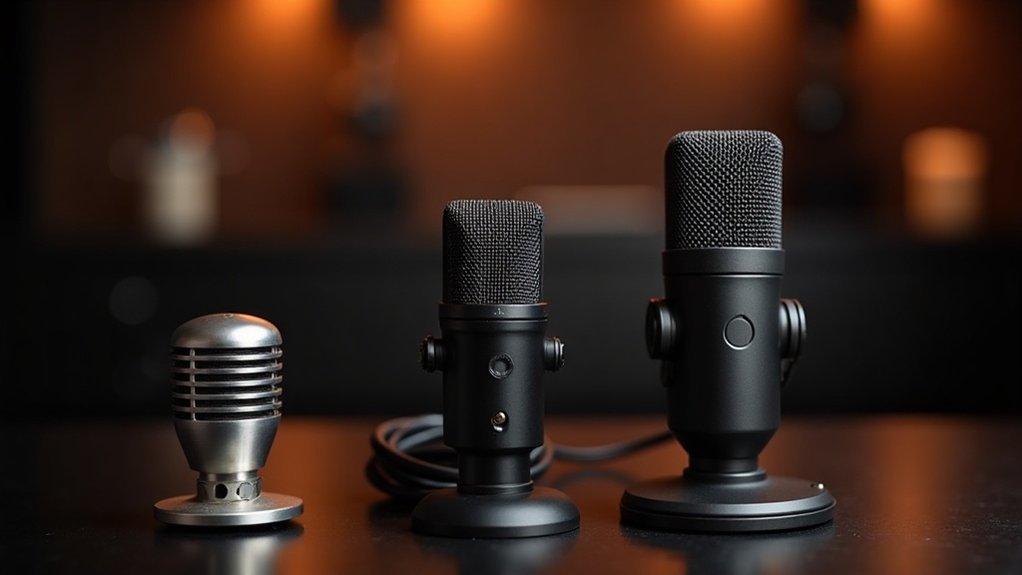
Once you’ve identified condenser microphones as your target category, the practical decision shifts to allocating your budget efficiently—a choice that mirrors the structure of the best singing microphones by budget.
At $150, you’re choosing between the AT2020 and AKG P120—workhorses that demand vocal technique and room treatment to shine. Condenser microphones in this price range utilize capacitor-based transduction to capture vocal nuance with impressive sensitivity.
The $300 tier introduces the AT2035, offering noticeably lower self-noise and smoother response, representing excellent value in singing microphones by budget categories.
By $500, the Rode NT2-A delivers professional transient detail and mix-ready tone.
Your progression through these best singing microphones at different price points mirrors industry standards: each tier trades improved self-noise performance and frequency refinement for precision vocal capture.
Whether you’re a creator, musician, or professional recording vocalist content, understanding how to allocate your microphone budget across these three tiers ensures maximum return on investment.
Proper microphone maintenance and disciplined vocal technique remain non-negotiable regardless of investment level, making the choice of which singing microphone fits your budget one of the most critical decisions in your recording setup.
Cardioid Patterns and Pickup: Why They Matter for Your Voice
For creators and musicians on any budget, mastering cardioid patterns for pickup sensitivity transforms your recording quality without requiring treated studio spaces or expensive equipment upgrades.
Find Your Perfect Fit: Match Voice Type, Room Acoustics, and Gear
Live performances demand cardioid patterns for feedback rejection, another essential consideration when working to match gear to your application. For studio recording, USB microphones offer plug-and-play convenience without additional audio interfaces, while XLR options provide professional flexibility and mic preamp control.
Professional microphone brands like Shure and Sennheiser offer proven solutions across these categories, helping you navigate the process of finding affordable options without sacrificing quality. Matching voice type, room acoustics, and gear through systematic assessment guarantees you’ll capture your authentic vocal identity using appropriate recording techniques.
Whether you’re podcasting, streaming, gaming, or recording music, this structured approach to matching your perfect microphone fit ensures every creator, gamer, musician, and professional invests in equipment truly suited to their unique situation.